

Achilles tendon rupture
Torn your Achilles? Get a rehab plan that rebuilds real strength
You felt a pop at the back of your ankle, and now you cannot push off, walk properly or trust the leg. An Achilles tendon rupture is a serious injury, and structured rehabilitation gets you loading that tendon again.
Medicare, NDIS, DVA and private health funds accepted.
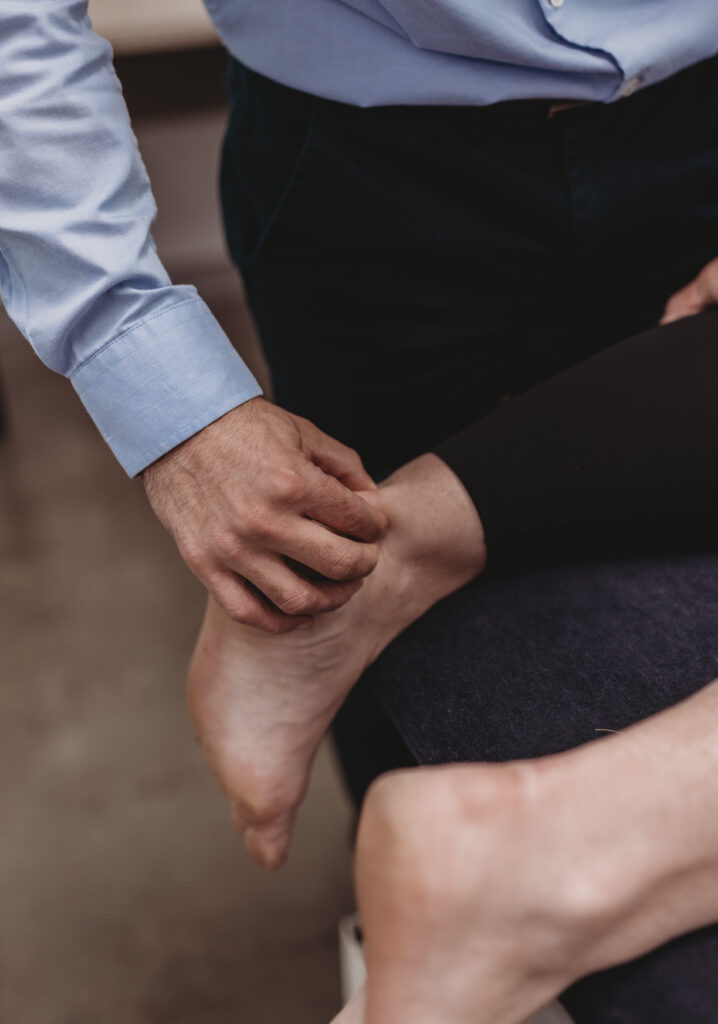
Understanding Achilles tendon rupture
An Achilles tendon rupture is a tear through the tendon that connects your calf muscles to your heel bone. It usually happens suddenly during a push-off, and it often comes with a pop, sharp pain and a leg that will not power you forward.
Whether your rupture is managed in a boot or with surgery, the recovery is the same in one important way: the tendon and calf need progressive loading to regain strength. That is what your physiotherapist plans, measures and adjusts.
Who does it affect?
most often active adults aged 30 to 50, and people returning to sport after a break.
How common is it?
one of the more frequently ruptured tendons in the body, and rates have risen with recreational sport participation.
What is the recovery like?
recovery varies, and it is usually measured in months rather than weeks, with return to running late in the process.
Who should I see for treatment?
your physiotherapist, working alongside your GP, surgeon or sports physician where surgery or imaging is involved.
What funding options are available?
Medicare, NDIS, DVA and private health funds accepted.
What is an Achilles tendon rupture?
Your Achilles tendon is the thick cord running from your calf muscles down to your heel bone. It transfers the force that lets you walk, climb stairs, run and jump. A rupture means that cord has torn, either partly or all the way through.
Most ruptures happen in a single moment: a sprint start, a jump landing, a change of direction, or a step that loads the ankle faster than expected. In many cases the tendon already had some quiet degeneration, so it tore under a load it once handled without trouble.
Things that raise your risk include:
Being aged roughly 30 to 50 and playing stop-start sport such as basketball, netball, football or tennis
A sudden jump in training load, or returning to sport after months away
Existing Achilles tendinopathy, which is pain and change in the tendon tissue over time
Corticosteroid injections around the tendon, or fluoroquinolone antibiotics
A previous Achilles injury or rupture on either leg
Sports and jobs that involve repeated jumping, sprinting or heavy carrying
Symptoms of Achilles tendon rupture
An Achilles tendon rupture usually announces itself. Common signs include:
Sudden sharp pain at the back of the ankle, often described as being kicked or hit from behind
An audible pop or snap at the moment of injury
Difficulty pushing off, climbing stairs or rising onto your toes
A gap or dip you can feel in the tendon a few centimetres above the heel
Swelling and bruising around the heel, ankle and lower calf
Weakness or no power at all when you try a single-leg heel raise
Your rehabilitation plan comes out of the assessment, and it accounts for whether your rupture is managed in a boot or after surgical repair.
What to expect at your first appointment
Tell us what is going on
How the injury happened, what you felt, what treatment or surgery you have had, and what you need to get back to.
A full assessment
Your physiotherapist examines the tendon, tests calf strength and ankle movement, watches how you walk, and checks the rest of the leg.
A clear plan
You leave knowing your current stage, what your exercises are, what to avoid, and what the next milestone looks like.
Review and adjust
Loading is progressed as your strength and tolerance improve, and coordinated with your surgeon or GP where needed.
When to book an appointment
You’ve experienced a sudden pop or snap in your Achilles, followed by pain, swelling, weakness or difficulty pushing off.
You cannot push off, walk normally or rise onto your toes on one leg
Your boot or post-surgical follow-up has finished and progress has stalled
You are not sure whether you have a rupture, a partial tear or tendinopathy
Book an assessment if:
Looking after yourself at home
Alongside your program, these habits support the tendon while it heals:
Being aged roughly 30 to 50 and playing stop-start sport such as basketball, netball, football or tennis
A sudden jump in training load, or returning to sport after months away
Existing Achilles tendinopathy, which is pain and change in the tendon tissue over time
Corticosteroid injections around the tendon, or fluoroquinolone antibiotics
A previous Achilles injury or rupture on either leg
Sports and jobs that involve repeated jumping, sprinting or heavy carrying

Meet the team who treat this
Behind every appointment is a team of practitioners who know each other, trust each other and work together for you. Across seven clinics and nine disciplines, our team shares expertise, coordinates treatment plans and celebrates your progress together.

Aimee Fuller
Healthcare Support Officer
Available at Blaxland

Alicia Whiticker
Healthcare Support Officer
Available at Blaxland

Amanda Banks
Healthcare Support Officer
Available at Blaxland

Amanda Duggan
Healthcare Support Officer
Available at Blaxland

Amy Meekings
Healthcare Support Officer
Available at Blaxland

Anita Beerapu
Healthcare Support Officer
Available at Blaxland
Benjamin Tucker
Healthcare Support Officer
Available at Blaxland

Blake Cossar
Healthcare Support Officer
Available at Blaxland

Bronte Tupper
Healthcare Support Officer
Available at Blaxland

Chris Farrugia
Healthcare Support Officer
Available at Blaxland

Corrina Aitken
Healthcare Support Officer
Available at Blaxland

David Logue
Healthcare Support Officer
Available at Blaxland

Dean Gresser
Healthcare Support Officer
Available at Blaxland

Emma Nassif
Healthcare Support Officer
Available at Blaxland

Esha Sharma
Healthcare Support Officer
Available at Blaxland

Fatima Hussaini
Healthcare Support Officer
Available at Blaxland

Felicity Spencer-Davey
Healthcare Support Officer
Available at Blaxland

Frankie Raikadroka
Healthcare Support Officer
Available at Blaxland
Hannah Norrie
Healthcare Support Officer
Available at Blaxland
Heather Edwards
Healthcare Support Officer
Available at Blaxland

Isaac Vella
Healthcare Support Officer
Available at Blaxland

Jarrah Nesbitt
Healthcare Support Officer
Available at Blaxland

Jonathan Lopez
Healthcare Support Officer
Available at Blaxland

Justin Hanna
Healthcare Support Officer
Available at Blaxland

Kasey Collins
Healthcare Support Officer
Available at Blaxland

Katrina Gauci
Healthcare Support Officer
Available at Blaxland

Kennedy Touet
Healthcare Support Officer
Available at Blaxland

Kristy Edwards
Healthcare Support Officer
Available at Blaxland

Kyle Perry
Healthcare Support Officer
Available at Blaxland

Lorna Nicastri
Healthcare Support Officer
Available at Blaxland

Maja Bosic
Healthcare Support Officer
Available at Blaxland

Marxy Koronel
Healthcare Support Officer
Available at Blaxland

Matt Barton
Healthcare Support Officer
Available at Blaxland

Michael Todd
Healthcare Support Officer
Available at Blaxland

Mr Jeffery Jenkins FACPS
Healthcare Support Officer
Available at Blaxland

Nathan Cavanagh
Healthcare Support Officer
Available at Blaxland

Patrick Celeban
Healthcare Support Officer
Available at Blaxland

Praise Khin
Healthcare Support Officer
Available at Blaxland

Sarah Bonnici
Healthcare Support Officer
Available at Blaxland

Shannon Smith
Healthcare Support Officer
Available at Blaxland

Siobhan Kelly
Healthcare Support Officer
Available at Blaxland

Taleisha Bozzi
Healthcare Support Officer
Available at Blaxland

Trystan Singh
Healthcare Support Officer
Available at Blaxland

Uty Kotwal
Healthcare Support Officer
Available at Blaxland

Yoni Hochberg
Healthcare Support Officer
Available at Blaxland

Zak Lloyd
Healthcare Support Officer
Available at Blaxland
EPC, DVA, NDIS and WorkCover welcome
Nearly half of our appointments are funded through Medicare, DVA, NDIS or WorkCover. We manage the paperwork so you can focus on your health.

NDIS
We support eligible NDIS participants across podiatry, physiotherapy, exercise physiology, dietetics and psychology, depending on your plan and goals. Eligibility and funding are set by your plan.

Medicare
Medicare may rebate podiatry, physiotherapy, exercise physiology and dietetics sessions when your GP refers you under an Enhanced Primary Care (EPC) or Chronic Disease Management (CDM) plan, and psychology sessions under a Mental Health Care Plan. The number of sessions is set by your plan.

DVA
Gold and White card holders can access DVA-funded care across our services with a valid referral.

WorkCover
If you have been injured at work, we accept WorkCover referrals for physiotherapy, exercise physiology and psychology, and manage the paperwork with your insurer, with a clear return-to-work plan.
Seven clinics across three regions
Find a clinic near you. Each location is staffed by local practitioners who know your community.
Penrith
Western SydneyOur largest centre, with our full range of services under one roof.
Ropes Crossing
Western SydneyPodiatry, at Ropes Crossing Village.
Blaxland
Blue MountainsPodiatry, physiotherapy, exercise physiology and group classes.
Springwood
Blue MountainsPodiatry, dietetics and a boutique footwear store.
Katoomba
Blue MountainsPodiatry, physiotherapy and dietetics, in a restored 1914 cottage.
Ryde
North ShorePodiatry, physiotherapy, dietetics and exercise physiology, with a footwear store and gait analysis.
Lindfield
North ShorePodiatry, with mobile podiatry across the North Shore and Northern Beaches.
Ready to get moving again after an Achilles rupture?
Book an assessment and get a staged plan that takes you from boot to full strength.














Frequently asked questions
Is surgery better than a boot for an Achilles rupture?
Both are accepted options, and neither is automatically better. Modern non-surgical management uses a boot with early controlled loading, and outcomes are often comparable to surgery for many people. Surgery may be favoured for elite athletes, delayed diagnoses or certain tear patterns. The decision sits with you, your GP and your surgeon, and it takes into account your age, activity and general health. Rehabilitation matters either way.
Why do Achilles ruptures happen so often in your 30s, 40s and 50s?
Tendon tissue changes with age, losing some elasticity and blood supply, while many people in this age group still play fast, stop-start sport. The combination is the risk: a tendon with quiet degeneration meeting a sudden explosive load, often in a social game after a week at a desk. Building calf strength and increasing training load gradually can reduce that mismatch.
Can an Achilles tendon rupture happen again after it has healed?
Yes, re-rupture is possible, and it is most likely in the first few months while the healing tendon is still remodelling. The risk is higher if you return to sprinting, jumping or sport before calf strength and hop testing show you are ready. Following your loading progressions, and completing the late-stage plyometric work rather than stopping once you can walk comfortably, reduces that risk.
When can I drive again after an Achilles rupture?
Driving depends on which leg is injured, whether you are still in a boot, and whether your car is automatic or manual. Most insurers do not cover driving in a moon boot, so check your policy. Your physiotherapist can test braking reaction and control on the injured side, but final clearance should be confirmed with your GP or surgeon.
Will my calf ever get back to full size and strength?
Most people regain good function, though some calf size difference and a small heel raise height deficit can persist, particularly if strength work stops early. The best results come from continuing heavy calf loading well past the point where walking feels normal. Your physiotherapist measures both legs, so progress is tracked against a number rather than a feeling.
Can I train the rest of my body while I am in a boot?
Yes, and it is encouraged. Upper body weights, core work, single-leg exercise on the uninjured side and seated cardio options such as an arm ergometer keep your fitness and muscle mass up. Staying active also helps mood and sleep during a long recovery. Your physiotherapist will tell you which positions to avoid so the healing tendon is not stretched or loaded too soon.