
Build a stronger, more durable young athlete
Your child keeps picking up niggles, tires late in games, or comes back from an injury never quite the same. Structured, supervised strength and conditioning can change that.
Medicare, NDIS, DVA and private health funds accepted.

Youth strength and conditioning is supervised training that builds strength, speed, coordination and resilience in growing bodies. Your exercise physiologist matches the program to your child’s stage of growth, their sport and everything else they already do each week.
Most families come to us for one of three reasons: recurring niggles that settle and return, a young athlete who wants to keep up with the pace of their sport, or a return to training after injury that needs a proper bridge back.
Who it is for: young people from school sport through to representative level, and teenagers who simply want to get stronger. [CONFIRM: age range accepted in the OnePointHealth youth program]
Timeframes: strength, control and confidence build over months rather than weeks, and progress varies with age, training history and growth stage.
Who does it affect?
How common is it?
most young athletes train their sport several times a week and do no structured strength work at all.
What is the recovery like?
Who should I see for treatment?
accredited exercise physiologists.
What funding options are available?
Medicare, NDIS, DVA and private health funds accepted.
What is youth strength and conditioning?
Youth strength and conditioning is coached physical preparation for people who are still growing. It covers strength, jumping and landing, sprinting, change of direction, and how much of each your child can handle in a week.
The need usually appears in the early teenage years. Training loads climb, bodies change quickly, and the tissue that has to absorb all of it has not caught up. That mismatch is where most niggles start.
Common contributing factors include:
Rapid growth spurts, which temporarily change limb length, coordination and tendon load
Early specialisation in one sport, with the same movement repeated year round
Rising club, school and representative demands with little planned recovery
Gaps in basic strength, particularly through the hips, calves and trunk

Symptoms of Youth strength and conditioning
Niggles in the knees, heels, shins or hips that settle with rest and return with training
Fading physically in the last quarter, or getting outmuscled in contests
Poor landing and change of direction control, often noticed by a coach first
Coming back from an injury with less confidence, or favouring one side
Your child's program comes out of their assessment, their sport and their current training week.
What to expect at your first appointment
Tell us what is going on
Your exercise physiologist asks about your child’s sports, weekly schedule, injury history, goals and any growth-related pain.
A full assessment
We test strength, balance, jumping and landing, movement quality and, where relevant, the injured area.
A clear plan
You leave with a written program, an explanation of why each part is there, and a realistic session frequency.
Review and adjust
We retest as your child progresses, and change the plan around seasons, growth and competition.
When to book an appointment
Pain has lasted more than two weeks, or keeps returning every time training ramps up
Your child is missing training, sitting out games or holding back in contests
Rest, stretching and strapping have not fixed the problem
You are not sure what is safe for your child to lift or how much they should be doing
Book an assessment if:
Looking after your lower back at home
These strategies suit most people with recent, uncomplicated back pain, and work alongside treatment rather than replacing it.
Rapid growth spurts, which temporarily change limb length, coordination and tendon load
Early specialisation in one sport, with the same movement repeated year round
Rising club, school and representative demands with little planned recovery
Gaps in basic strength, particularly through the hips, calves and trunk
Meet the team who treat this
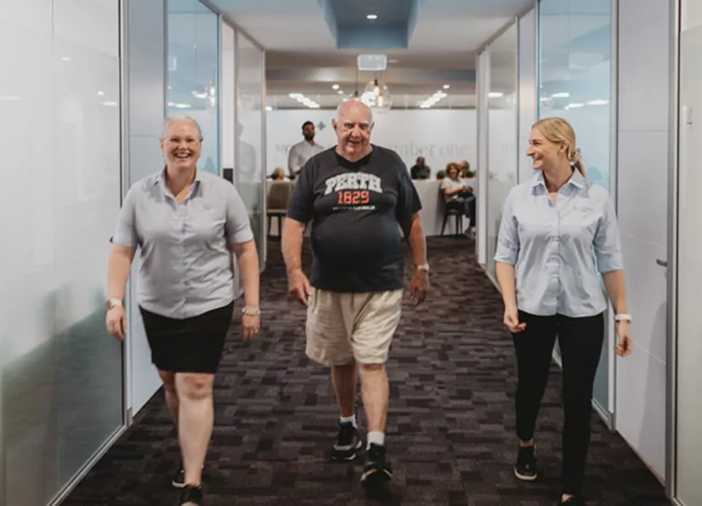
Behind every appointment is a team of practitioners who know each other, trust each other and work together for you. Across seven clinics and nine disciplines, our team shares expertise, coordinates treatment plans and celebrates your progress together.

Abijith Anand
Healthcare Support Officer
Available at Blaxland

Aimee Fuller
Healthcare Support Officer
Available at Blaxland

Alicia Whiticker
Healthcare Support Officer
Available at Blaxland

Amanda Banks
Healthcare Support Officer
Available at Blaxland

Amanda Duggan
Healthcare Support Officer
Available at Blaxland

Amy Meekings
Healthcare Support Officer
Available at Blaxland

Anita Beerapu
Healthcare Support Officer
Available at Blaxland
Benjamin Tucker
Healthcare Support Officer
Available at Blaxland
Blake Ciscato
Healthcare Support Officer
Available at Blaxland

Blake Cossor
Healthcare Support Officer
Available at Blaxland

Bronte Tupper
Healthcare Support Officer
Available at Blaxland
Callum Thorpe
Healthcare Support Officer
Available at Blaxland

Carin Bloom
Healthcare Support Officer
Available at Blaxland

Charli Haddow
Healthcare Support Officer
Available at Blaxland

Chris Farrugia
Healthcare Support Officer
Available at Blaxland

Chris Moulds
Healthcare Support Officer
Available at Blaxland

Ciara O’Kane
Healthcare Support Officer
Available at Blaxland
Claudia Thomas
Healthcare Support Officer
Available at Blaxland

Corrina Aitken
Healthcare Support Officer
Available at Blaxland

David Logue
Healthcare Support Officer
Available at Blaxland

Dean Gresser
Healthcare Support Officer
Available at Blaxland

Emma Nassif
Healthcare Support Officer
Available at Blaxland

Emma Scanlon
Healthcare Support Officer
Available at Blaxland

Erin Burns
Healthcare Support Officer
Available at Blaxland
Esha Sharma
Healthcare Support Officer
Available at Blaxland

Ester Iskandar
Healthcare Support Officer
Available at Blaxland

Evangelina Papalia
Healthcare Support Officer
Available at Blaxland
Fatima Hussaini
Healthcare Support Officer
Available at Blaxland
Felicity Spencer-Davey
Healthcare Support Officer
Available at Blaxland

Frankie Raikadroka
Healthcare Support Officer
Available at Blaxland
Hannah Norrie
Healthcare Support Officer
Available at Blaxland

Harrison Gregson
Healthcare Support Officer
Available at Blaxland
Heather Edwards
Healthcare Support Officer
Available at Blaxland

Isaac Vella
Healthcare Support Officer
Available at Blaxland
Jarrah Nesbitt
Healthcare Support Officer
Available at Blaxland

Jasmine Apap
Healthcare Support Officer
Available at Blaxland
Jessica Orchard
Healthcare Support Officer
Available at Blaxland

Jonathan Lopez
Healthcare Support Officer
Available at Blaxland

Justin Hanna
Healthcare Support Officer
Available at Blaxland

Kasey Collins
Healthcare Support Officer
Available at Blaxland

Katrina Gauci
Healthcare Support Officer
Available at Blaxland

Kennedy Touet
Healthcare Support Officer
Available at Blaxland

Kristy Edwards
Healthcare Support Officer
Available at Blaxland

Kurt White
Healthcare Support Officer
Available at Blaxland

Kyle Perry
Healthcare Support Officer
Available at Blaxland

Kylie Saba
Healthcare Support Officer
Available at Blaxland

Lorna Nicastri
Healthcare Support Officer
Available at Blaxland
Lucas Barglik
Healthcare Support Officer
Available at Blaxland
Mackenzie Gleeson
Healthcare Support Officer
Available at Blaxland

Madeleine Vella
Healthcare Support Officer
Available at Blaxland

Maja Bosic
Healthcare Support Officer
Available at Blaxland

Marxy Koronel
Healthcare Support Officer
Available at Blaxland

Matt Barton
Healthcare Support Officer
Available at Blaxland

Mia Nikic
Healthcare Support Officer
Available at Blaxland

Michael Todd
Healthcare Support Officer
Available at Blaxland

Mr Jeffery Jenkins FACPS
Healthcare Support Officer
Available at Blaxland

Nathan Cavanagh
Healthcare Support Officer
Available at Blaxland

Oren Schulze
Healthcare Support Officer
Available at Blaxland
Patience Namiiro
Healthcare Support Officer
Available at Blaxland

Patrick Celeban
Healthcare Support Officer
Available at Blaxland

Paul Sawaqed
Healthcare Support Officer
Available at Blaxland

Phillip Hartshorne
Healthcare Support Officer
Available at Blaxland

Praise Khin
Healthcare Support Officer
Available at Blaxland

Rebecca Samuels
Healthcare Support Officer
Available at Blaxland

Rianna Nicotera
Healthcare Support Officer
Available at Blaxland

Sarah Bonnici
Healthcare Support Officer
Available at Blaxland

Sarah Fenter
Healthcare Support Officer
Available at Blaxland

Shannon Smith
Healthcare Support Officer
Available at Blaxland

Shara Percival
Healthcare Support Officer
Available at Blaxland

Sherie Casson
Healthcare Support Officer
Available at Blaxland
Siobhan Kelly
Healthcare Support Officer
Available at Blaxland

Summer Watson
Healthcare Support Officer
Available at Blaxland

Taleisha Bozzi
Healthcare Support Officer
Available at Blaxland
Tori McLean
Healthcare Support Officer
Available at Blaxland

Trystan Singh
Healthcare Support Officer
Available at Blaxland

Uty Kotwal
Healthcare Support Officer
Available at Blaxland

Veronica Theiss
Healthcare Support Officer
Available at Blaxland

Yoni Hochberg
Healthcare Support Officer
Available at Blaxland

Zak Lloyd
Healthcare Support Officer
Available at Blaxland
Zane Awik
Healthcare Support Officer
Available at Blaxland
EPC, DVA, NDIS and WorkCover welcome
Nearly half of our appointments are funded through Medicare, DVA, NDIS or WorkCover. We manage the paperwork so you can focus on your health.

NDIS
We support eligible NDIS participants across podiatry, physiotherapy, exercise physiology, dietetics and psychology, depending on your plan and goals. Eligibility and funding are set by your plan.

Medicare
Medicare may rebate podiatry, physiotherapy, exercise physiology and dietetics sessions when your GP refers you under an Enhanced Primary Care (EPC) or Chronic Disease Management (CDM) plan, and psychology sessions under a Mental Health Care Plan. The number of sessions is set by your plan.

DVA
Gold and White card holders can access DVA-funded care across our services with a valid referral.

WorkCover
If you have been injured at work, we accept WorkCover referrals for physiotherapy, exercise physiology and psychology, and manage the paperwork with your insurer, with a clear return-to-work plan.
Seven clinics across three regions
Find a clinic near you. Each location is staffed by local practitioners who know your community.
Penrith
Western SydneyOur largest centre, with our full range of services under one roof.
TBD
Ropes Crossing
Western SydneyPodiatry, at Ropes Crossing Village.
TBD
Blaxland
Western SydneyPodiatry, physiotherapy, exercise physiology and group classes.
TBD
Springwood
Western SydneyPodiatry, dietetics and a boutique footwear store.
TBD
Katoomba
Western SydneyPodiatry, physiotherapy, dietetics and psychology, in a restored 1914 cottage.
TBD
Ryde
Western SydneyPodiatry, physiotherapy, dietetics, exercise physiology and psychology, with a footwear store and gait analysis.
TBD
Lindfield
Western SydneyPodiatry, with mobile podiatry across the North Shore and Northern Beaches.
TBD
Ready to set your young athlete up for a better season?
Book an assessment with an exercise physiologist and get a program built around your child’s sport and schedule.






Frequently asked questions
At what age can my child start strength training?
Children can start structured strength work once they can follow instruction and hold a position under supervision, often from around seven or eight with bodyweight movements. External load is introduced later, based on technique and training experience rather than birthday. Younger children focus on coordination, hopping, landing and general movement skill, which builds the base that heavier training later relies on. [CONFIRM: minimum age accepted in the OnePointHealth youth program]
Will lifting weights stunt my child's growth?
No. Supervised resistance training with appropriate technique and load has not been shown to damage growth plates or reduce adult height. That concern came from older reports of injuries during unsupervised maximal lifting, usually with poor technique. In practice, growth plate injuries in young people are far more likely to come from a fall or a collision during sport than from a coached strength session.
How is this different from personal training at a gym?
An exercise physiologist is a university-qualified allied health professional, so they can work with growing bodies, current injuries and medical conditions. Sessions are assessment-led, documented and adjusted around club training and competition. Programs can also be claimed through private health extras or a Medicare care plan where your child is eligible, which is not available for personal training.
Can my child keep training if their knees or heels hurt during a growth spurt?
Often yes, with changes. Osgood-Schlatter at the knee and Sever’s at the heel are common during rapid growth and usually settle as growth slows. Instead of stopping everything, your exercise physiologist reduces jumping and sprinting volume, keeps strength work going in pain-free ranges, and rebuilds impact tolerance in stages. Complete rest tends to leave young athletes weaker when they return.
Can my child join if they have never lifted a weight before?
Yes, and that is the most common starting point. Programs begin with bodyweight movements and technique, not loaded lifts. Your exercise physiologist teaches each movement pattern first and only adds resistance once it is performed well, so a complete beginner is not at a disadvantage and does not need any preparation before their first session.
My child already trains four nights a week. Will this add too much?
Not if it is planned properly, and the whole point is that it is. Your exercise physiologist maps your child’s full week first, including club training, school sport and games, then fits strength work around it, often replacing junk volume rather than stacking on top. During heavy competition periods the program shrinks deliberately. Total load is managed as one number across everything, not sport plus extras.