
Get your tendon loading properly again
The pain is sharp when you start, eases as you warm up, then bites again the next morning. Tendonitis responds well to the right loading plan, and your physiotherapist or podiatrist can build one for you.
Medicare, NDIS, DVA and private health funds accepted.

Tendonitis is pain, swelling and loss of strength in a tendon, the tough cord that joins muscle to bone. It usually starts when the load on a tendon rises faster than the tendon can adapt to, through new training, a heavier work roster or a change in footwear.
Treatment is not rest alone. Your physiotherapist or podiatrist works out which tendon is involved, what overloaded it, and how much load it can handle now, then builds strength back up in steps you can tolerate.
Who does it affect?
anyone who loads a tendon repeatedly, from runners and tradespeople to office workers and gardeners.
How common is it?
tendon problems are among the most frequent reasons people seek treatment for pain in the limbs.
What is the recovery like?
varies with the tendon, how long the pain has been there and how much load you need to return to.
Who should I see for treatment?
physiotherapists, and podiatrists for tendons in the foot, ankle and lower leg.
What funding options are available?
Medicare, NDIS, DVA and private health funds accepted.
What is tendonitis?
Tendonitis means pain and irritation in a tendon. The name suggests inflammation, and in the first few days that can be part of it. Once pain has been there for weeks, the tissue changes are usually structural rather than inflammatory, which is why clinicians often use the term tendinopathy.
It builds up rather than snapping on. The tendon takes on more load than it has been prepared for, the fibres struggle to keep up with repair, and the tendon becomes painful and less able to store and release energy.
Common contributing factors include:
A sudden jump in training volume, speed, hills or hours on your feet
Long gaps in activity followed by a fast return
Footwear changes, worn-out shoes or a new work surface
Weakness in the muscle group above the painful tendon
Health factors such as diabetes, high cholesterol or some medications

Symptoms of Tendonitis
Tendonitis usually presents as:
Pain at one clear point on or near the tendon, rather than spread across a whole area
Pain that is worst on the first few steps or movements, then eases as you warm up
Pain that returns the following morning after a heavy day
Stiffness after sitting still or after sleep
Swelling, thickening or a lump you can feel along the tendon
Reduced strength or push-off power on that side
Your plan comes out of the assessment, not out of a template.
What to expect at your first appointment
Tell us what is going on
You describe where the pain sits, when it started, what makes it worse and what you need to get back to.
A full assessment
We test strength, movement and how the tendon responds to load, and check the joints and muscles around it.
A clear plan
You leave knowing which tendon is involved, what to change now, and the exercises to start with.
Review and adjust
We recheck your strength and pain response, then progress the loading as the tendon takes on more.
When to book an appointment
Tendon pain has lasted more than two weeks, or keeps returning each time you train
It is limiting your work, sport, stairs or sleep
Rest, ice and anti-inflammatories have not changed anything
You are not sure whether it is the tendon, the joint or a nerve
Book an assessment if:
Looking after your lower back at home
These strategies suit most people with recent, uncomplicated back pain, and work alongside treatment rather than replacing it.
A sudden jump in training volume, speed, hills or hours on your feet
Long gaps in activity followed by a fast return
Footwear changes, worn-out shoes or a new work surface
Weakness in the muscle group above the painful tendon
Health factors such as diabetes, high cholesterol or some medications

Meet the team who treat this
Behind every appointment is a team of practitioners who know each other, trust each other and work together for you. Across seven clinics and nine disciplines, our team shares expertise, coordinates treatment plans and celebrates your progress together.

Abijith Anand
Healthcare Support Officer
Available at Blaxland

Aimee Fuller
Healthcare Support Officer
Available at Blaxland

Alicia Whiticker
Healthcare Support Officer
Available at Blaxland

Amanda Banks
Healthcare Support Officer
Available at Blaxland

Amanda Duggan
Healthcare Support Officer
Available at Blaxland

Amy Meekings
Healthcare Support Officer
Available at Blaxland

Anita Beerapu
Healthcare Support Officer
Available at Blaxland

Benjamin Tucker
Healthcare Support Officer
Available at Blaxland

Blake Ciscato
Healthcare Support Officer
Available at Blaxland

Blake Cossor
Healthcare Support Officer
Available at Blaxland

Bronte Tupper
Healthcare Support Officer
Available at Blaxland

Callum Thorpe
Healthcare Support Officer
Available at Blaxland

Carin Bloom
Healthcare Support Officer
Available at Blaxland

Charli Haddow
Healthcare Support Officer
Available at Blaxland

Chris Farrugia
Healthcare Support Officer
Available at Blaxland

Chris Moulds
Healthcare Support Officer
Available at Blaxland

Ciara O’Kane
Healthcare Support Officer
Available at Blaxland
Claudia Thomas
Healthcare Support Officer
Available at Blaxland

Corrina Aitken
Healthcare Support Officer
Available at Blaxland

David Logue
Healthcare Support Officer
Available at Blaxland

Dean Gresser
Healthcare Support Officer
Available at Blaxland

Emma Nassif
Healthcare Support Officer
Available at Blaxland

Emma Scanlon
Healthcare Support Officer
Available at Blaxland

Erin Burns
Healthcare Support Officer
Available at Blaxland

Esha Sharma
Healthcare Support Officer
Available at Blaxland

Ester Iskandar
Healthcare Support Officer
Available at Blaxland

Evangelina Papalia
Healthcare Support Officer
Available at Blaxland

Fatima Hussaini
Healthcare Support Officer
Available at Blaxland

Felicity Spencer-Davey
Healthcare Support Officer
Available at Blaxland

Frankie Raikadroka
Healthcare Support Officer
Available at Blaxland

Hannah Norrie
Healthcare Support Officer
Available at Blaxland

Harrison Gregson
Healthcare Support Officer
Available at Blaxland

Heather Edwards
Healthcare Support Officer
Available at Blaxland

Isaac Vella
Healthcare Support Officer
Available at Blaxland

Jarrah Nesbitt
Healthcare Support Officer
Available at Blaxland

Jasmine Apap
Healthcare Support Officer
Available at Blaxland

Jessica Orchard
Healthcare Support Officer
Available at Blaxland

Jonathan Lopez
Healthcare Support Officer
Available at Blaxland

Justin Hanna
Healthcare Support Officer
Available at Blaxland

Kasey Collins
Healthcare Support Officer
Available at Blaxland

Katrina Gauci
Healthcare Support Officer
Available at Blaxland

Kennedy Touet
Healthcare Support Officer
Available at Blaxland

Kristy Edwards
Healthcare Support Officer
Available at Blaxland

Kurt White
Healthcare Support Officer
Available at Blaxland

Kyle Perry
Healthcare Support Officer
Available at Blaxland

Kylie Saba
Healthcare Support Officer
Available at Blaxland

Lorna Nicastri
Healthcare Support Officer
Available at Blaxland
Lucas Barglik
Healthcare Support Officer
Available at Blaxland

Mackenzie Gleeson
Healthcare Support Officer
Available at Blaxland

Madeleine Vella
Healthcare Support Officer
Available at Blaxland

Maja Bosic
Healthcare Support Officer
Available at Blaxland

Marxy Koronel
Healthcare Support Officer
Available at Blaxland

Matt Barton
Healthcare Support Officer
Available at Blaxland

Mia Nikic
Healthcare Support Officer
Available at Blaxland

Michael Todd
Healthcare Support Officer
Available at Blaxland

Mr Jeffery Jenkins FACPS
Healthcare Support Officer
Available at Blaxland

Nathan Cavanagh
Healthcare Support Officer
Available at Blaxland

Oren Schulze
Healthcare Support Officer
Available at Blaxland

Patience Namiiro
Healthcare Support Officer
Available at Blaxland

Patrick Celeban
Healthcare Support Officer
Available at Blaxland

Paul Sawaqed
Healthcare Support Officer
Available at Blaxland

Phillip Hartshorne
Healthcare Support Officer
Available at Blaxland

Praise Khin
Healthcare Support Officer
Available at Blaxland

Rebecca Samuels
Healthcare Support Officer
Available at Blaxland

Rianna Nicotera
Healthcare Support Officer
Available at Blaxland

Sarah Bonnici
Healthcare Support Officer
Available at Blaxland

Sarah Fenter
Healthcare Support Officer
Available at Blaxland

Shannon Smith
Healthcare Support Officer
Available at Blaxland

Shara Percival
Healthcare Support Officer
Available at Blaxland

Sherie Casson
Healthcare Support Officer
Available at Blaxland

Siobhan Kelly
Healthcare Support Officer
Available at Blaxland

Summer Watson
Healthcare Support Officer
Available at Blaxland

Taleisha Bozzi
Healthcare Support Officer
Available at Blaxland

Tori McLean
Healthcare Support Officer
Available at Blaxland

Trystan Singh
Healthcare Support Officer
Available at Blaxland

Uty Kotwal
Healthcare Support Officer
Available at Blaxland

Veronica Theiss
Healthcare Support Officer
Available at Blaxland

Yoni Hochberg
Healthcare Support Officer
Available at Blaxland

Zak Lloyd
Healthcare Support Officer
Available at Blaxland

Zane Awik
Healthcare Support Officer
Available at Blaxland
EPC, DVA, NDIS and WorkCover welcome
Nearly half of our appointments are funded through Medicare, DVA, NDIS or WorkCover. We manage the paperwork so you can focus on your health.


NDIS
We support eligible NDIS participants across podiatry, physiotherapy, exercise physiology, dietetics and psychology, depending on your plan and goals. Eligibility and funding are set by your plan.

Medicare
Medicare may rebate podiatry, physiotherapy, exercise physiology and dietetics sessions when your GP refers you under an Enhanced Primary Care (EPC) or Chronic Disease Management (CDM) plan, and psychology sessions under a Mental Health Care Plan. The number of sessions is set by your plan.

DVA
Gold and White card holders can access DVA-funded care across our services with a valid referral.

WorkCover
If you have been injured at work, we accept WorkCover referrals for physiotherapy, exercise physiology and psychology, and manage the paperwork with your insurer, with a clear return-to-work plan.
Made by us. Stocked by us. Worn by you
Great care is not just what happens in your appointment. It is what supports you in the thousands of steps you take between visits. Our footwear store and orthotics lab are both part of the OnePointHealth team, designed to keep your treatment working long after you have walked out the door.
Shoes our podiatrists wear and recommend
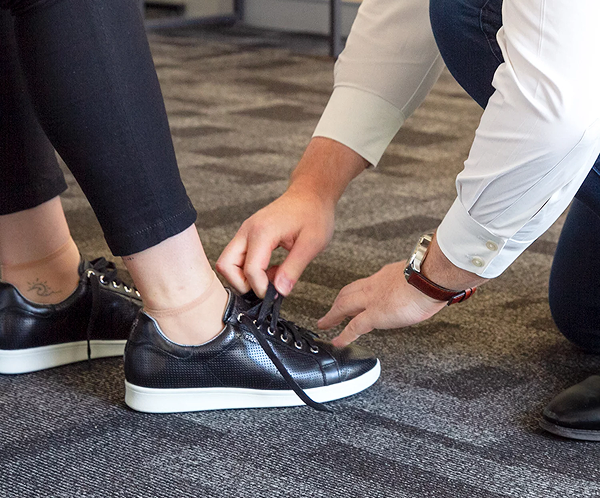
Footwear shapes how you move, how you recover and how comfortable you feel at the end of the day. Our podiatry team chooses the range stocked at our footwear store, which means the shoes on the shelf are the ones we genuinely recommend to our patients.
- Selected and reviewed by our podiatry team
- Fitted in person with biomechanical advice on hand
- Refreshed each season to reflect what is working for our patients
Featured products

Ziera Delilah XF Leather Sneaker
Ziera,
$269.99

Secra Poppy
Secra,
$129.99

Archies Arch Support Thongs Kids Pink
Archies,
$30.0

Mizuno Wave Rider 29
Mizuno,
$249.99
Seven clinics across three regions
Find a clinic near you. Each location is staffed by local practitioners who know your community.
Penrith
Western SydneyOur largest centre, with our full range of services under one roof.
TBD
Ropes Crossing
Western SydneyPodiatry, at Ropes Crossing Village.
TBD
Blaxland
Western SydneyPodiatry, physiotherapy, exercise physiology and group classes.
TBD
Springwood
Western SydneyPodiatry, dietetics and a boutique footwear store.
TBD
Katoomba
Western SydneyPodiatry, physiotherapy, dietetics and psychology, in a restored 1914 cottage.
TBD
Ryde
Western SydneyPodiatry, physiotherapy, dietetics, exercise physiology and psychology, with a footwear store and gait analysis.
TBD
Lindfield
Western SydneyPodiatry, with mobile podiatry across the North Shore and Northern Beaches.
TBD
Ready to get on top of that tendon pain?
Book an assessment, find out which tendon is involved, and start a loading plan that fits your week.






Frequently asked questions
Why do tendons take longer to settle than muscles?
Tendons have a much lower blood supply than muscle and a slower rate of collagen turnover, so the tissue rebuilds gradually. Muscle strains often feel better within a couple of weeks, while a tendon rebuilding its capacity to store and release load usually needs a longer, steadier program. That is why consistency with your exercises matters more than intensity in any single session.
Can medication cause tendon problems?
Yes. Some antibiotics in the fluoroquinolone family, such as ciprofloxacin, are linked with tendon pain and, rarely, tendon rupture. Long courses of corticosteroids and some cholesterol-lowering medications have also been associated with tendon symptoms. Do not stop a prescribed medication on your own. Tell your practitioner what you take, and raise any new tendon pain with your GP.
Should I take anti-inflammatory medication for tendonitis?
Anti-inflammatories may take the edge off pain in the first days after a flare, but they do not rebuild the tendon. Persistent tendon pain usually involves structural change rather than active inflammation, so tablets often make little difference after the early stage. Talk to your GP or pharmacist about whether they suit you, and use them alongside a loading plan rather than instead of one.
How much pain is acceptable while I exercise?
Most tendon programs allow pain up to about 3 or 4 out of 10 during exercise, provided it settles within 24 hours and is no worse the next morning. Pain that spikes higher, lingers into the following day or leaves you stiffer than usual is a sign the load was too much. Your physiotherapist sets your own threshold at the assessment.
Can tendonitis affect several tendons at once?
It can. When more than one tendon becomes painful without an obvious load spike, health factors are often involved: type 2 diabetes, high cholesterol, thyroid conditions, inflammatory arthritis or hormonal changes around menopause. Your practitioner will ask about these and may suggest you see your GP for blood tests. Addressing them alongside your exercise program supports how the tendon responds.
Can children and teenagers get tendonitis?
Growing children more often develop pain where a tendon attaches to a growth plate rather than in the tendon itself. Sever’s disease at the heel and Osgood-Schlatter disease at the knee are the common examples, and both usually follow a busy sports season. They are managed differently to adult tendon pain, so book an assessment rather than assuming it is the same problem.