

Bunions
Get the pressure off your big toe joint and back into comfortable shoes
That bump on the inside of your big toe joint rubs in every pair of shoes, and by the end of the day the joint aches. Bunions are common, and the pain they cause can be treated.
Medicare, NDIS, DVA and private health funds accepted.
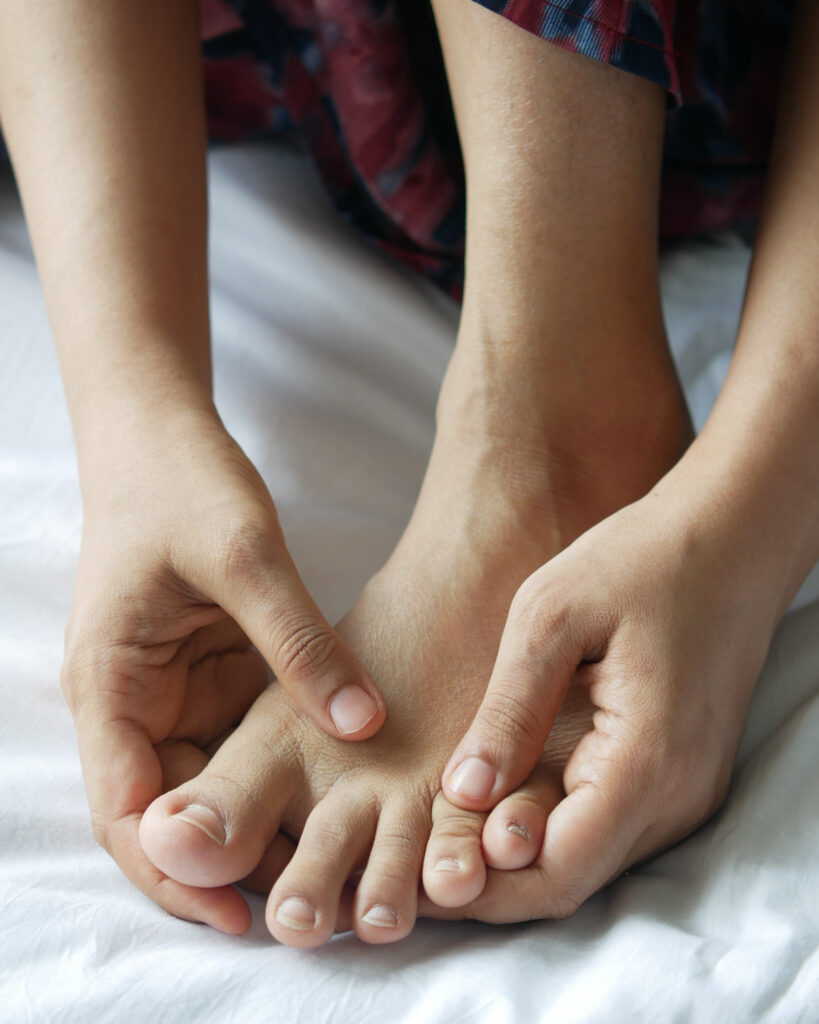
Understanding Bunions
A bunion is a change in the alignment of your big toe joint. The joint drifts outwards, your big toe angles across towards the smaller toes, and a bony bump forms on the inside of your foot.
Treatment focuses on your pain and the pressure through the joint. Your podiatrist can reduce the load going through the joint, settle the pain, and help you find footwear that stops the rubbing.
Who does it affect?
adults of any age, more often women, and sometimes teenagers with a strong family history.
How common is it?
bunions affect roughly one in four adults, and become more common with age [CONFIRM: prevalence figure and source].
What is the recovery like?
pain often settles with load and footwear changes, though timeframes vary and the bony change itself does not reverse.
Who should I see for treatment?
your podiatrist, with referral for a surgical opinion when it is warranted.
What funding options are available?
Medicare, NDIS, DVA and private health funds accepted.
What is a bunion?
A bunion, or hallux valgus, is a progressive change in the position of the joint at the base of your big toe. The bone behind the toe drifts towards the inside of your foot while the toe itself angles outwards, so the joint sits more prominently. The bump you can see is bone, not a growth.
Bunions usually develop slowly over years. As the angle increases, footwear presses on the joint, the protective sac of fluid over it can become inflamed, and load shifts across to the smaller toes.
Things that contribute include:
Foot biomechanics,, including the shape of the joint and family history
Narrow, tight or high-heeled footwear that squeezes the toes and loads the front of the foot
The way your foot rolls in as you walk, which increases force through the big toe joint at push-off
Hypermobile joints, or inflammatory conditions such as rheumatoid arthritis
Symptoms of Bunions
A firm bony bump on the inside of your foot at the base of the big toe
Redness, swelling or thickened skin over the bump where footwear rubs
Aching or burning in the joint after standing, walking or a long day in shoes
The big toe drifting towards the second toe, sometimes crowding or sitting under it
Stiffness in the joint, or less power when you push off
Corns between the toes, or callus building up under the ball of your foot
Your plan comes from your assessment, including how the joint moves, where the pressure sits and what you wear on your feet.
What to expect at your first appointment
Tell us what is going on
You describe where the pain is, how long you have had it, what makes it worse and which shoes you can still wear.
A full assessment
Your podiatrist checks the angle and movement of the joint, looks at pressure areas and callus, and watches how you walk.
A clear plan
You leave knowing what is causing your pain, what will help first, and what the options are if it progresses.
Review and adjust
You come back so your podiatrist can check what has changed and refine the plan, including any orthotic or footwear changes.
When to book an appointment
Big toe joint pain has lasted more than six weeks
The bunion limits which shoes you can wear, or how far you can walk, work or train
Wider shoes and padding have not changed your symptoms
You are not sure whether the pain is the bunion, joint arthritis or something else
Book an assessment if:
Looking after yourself at home
These steps help most people with bunion pain while you wait for your appointment.
Foot biomechanics,, including the shape of the joint and family history
Narrow, tight or high-heeled footwear that squeezes the toes and loads the front of the foot
The way your foot rolls in as you walk, which increases force through the big toe joint at push-off
Hypermobile joints, or inflammatory conditions such as rheumatoid arthritis

Meet the team who treat this
Behind every appointment is a team of practitioners who know each other, trust each other and work together for you. Across seven clinics and nine disciplines, our team shares expertise, coordinates treatment plans and celebrates your progress together.

Aimee Fuller
Healthcare Support Officer
Available at Blaxland

Alicia Whiticker
Healthcare Support Officer
Available at Blaxland

Amanda Banks
Healthcare Support Officer
Available at Blaxland

Amanda Duggan
Healthcare Support Officer
Available at Blaxland

Amy Meekings
Healthcare Support Officer
Available at Blaxland

Anita Beerapu
Healthcare Support Officer
Available at Blaxland

Benjamin Tucker
Healthcare Support Officer
Available at Blaxland

Blake Cossar
Healthcare Support Officer
Available at Blaxland

Bronte Tupper
Healthcare Support Officer
Available at Blaxland

Chris Farrugia
Healthcare Support Officer
Available at Blaxland

Corrina Aitken
Healthcare Support Officer
Available at Blaxland

David Logue
Healthcare Support Officer
Available at Blaxland

Dean Gresser
Healthcare Support Officer
Available at Blaxland

Emma Nassif
Healthcare Support Officer
Available at Blaxland

Esha Sharma
Healthcare Support Officer
Available at Blaxland

Fatima Hussaini
Healthcare Support Officer
Available at Blaxland

Felicity Spencer-Davey
Healthcare Support Officer
Available at Blaxland

Frankie Raikadroka
Healthcare Support Officer
Available at Blaxland

Hannah Norrie
Healthcare Support Officer
Available at Blaxland

Heather Edwards
Healthcare Support Officer
Available at Blaxland

Isaac Vella
Healthcare Support Officer
Available at Blaxland

Jarrah Nesbitt
Healthcare Support Officer
Available at Blaxland

Jonathan Lopez
Healthcare Support Officer
Available at Blaxland

Justin Hanna
Healthcare Support Officer
Available at Blaxland

Kasey Collins
Healthcare Support Officer
Available at Blaxland

Katrina Gauci
Healthcare Support Officer
Available at Blaxland

Kennedy Touet
Healthcare Support Officer
Available at Blaxland

Kristy Edwards
Healthcare Support Officer
Available at Blaxland

Kyle Perry
Healthcare Support Officer
Available at Blaxland

Lorna Nicastri
Healthcare Support Officer
Available at Blaxland

Maja Bosic
Healthcare Support Officer
Available at Blaxland

Marxy Koronel
Healthcare Support Officer
Available at Blaxland

Matt Barton
Healthcare Support Officer
Available at Blaxland

Michael Todd
Healthcare Support Officer
Available at Blaxland

Mr Jeffery Jenkins FACPS
Healthcare Support Officer
Available at Blaxland

Nathan Cavanagh
Healthcare Support Officer
Available at Blaxland

Patrick Celeban
Healthcare Support Officer
Available at Blaxland

Praise Khin
Healthcare Support Officer
Available at Blaxland

Sarah Bonnici
Healthcare Support Officer
Available at Blaxland

Shannon Smith
Healthcare Support Officer
Available at Blaxland

Siobhan Kelly
Healthcare Support Officer
Available at Blaxland

Taleisha Bozzi
Healthcare Support Officer
Available at Blaxland

Trystan Singh
Healthcare Support Officer
Available at Blaxland

Uty Kotwal
Healthcare Support Officer
Available at Blaxland

Yoni Hochberg
Healthcare Support Officer
Available at Blaxland

Zak Lloyd
Healthcare Support Officer
Available at Blaxland
EPC, DVA, NDIS and WorkCover welcome
Nearly half of our appointments are funded through Medicare, DVA, NDIS or WorkCover. We manage the paperwork so you can focus on your health.


NDIS
We support eligible NDIS participants across podiatry, physiotherapy, exercise physiology, dietetics and psychology, depending on your plan and goals. Eligibility and funding are set by your plan.

Medicare
Medicare may rebate podiatry, physiotherapy, exercise physiology and dietetics sessions when your GP refers you under an Enhanced Primary Care (EPC) or Chronic Disease Management (CDM) plan, and psychology sessions under a Mental Health Care Plan. The number of sessions is set by your plan.

DVA
Gold and White card holders can access DVA-funded care across our services with a valid referral.

WorkCover
If you have been injured at work, we accept WorkCover referrals for physiotherapy, exercise physiology and psychology, and manage the paperwork with your insurer, with a clear return-to-work plan.
Seven clinics across three regions
Find a clinic near you. Each location is staffed by local practitioners who know your community.
Penrith
Western SydneyOur largest centre, with our full range of services under one roof.
Ropes Crossing
Western SydneyPodiatry, at Ropes Crossing Village.
Blaxland
Blue MountainsPodiatry, physiotherapy, exercise physiology and group classes.
Springwood
Blue MountainsPodiatry, dietetics and a boutique footwear store.
Katoomba
Blue MountainsPodiatry, physiotherapy and dietetics, in a restored 1914 cottage.
Ryde
North ShorePodiatry, physiotherapy, dietetics and exercise physiology, with a footwear store and gait analysis.
Lindfield
North ShorePodiatry, with mobile podiatry across the North Shore and Northern Beaches.
Ready to stop your bunion dictating which shoes you wear?
Book a podiatry assessment and get a plan for the pain and the pressure.
















Frequently asked questions
Do bunions get worse over time?
Bunions tend to progress slowly, because the joint alignment does not correct itself. The speed varies a lot: some people see little change over a decade, others progress faster. Your podiatrist can measure the joint angle and, where useful, request an X-ray so there is a baseline to compare against at review. Managing load and footwear early gives the joint the best chance of staying comfortable.
Can toe spacers or bunion splints straighten my toe?
No. In adults, spacers and night splints do not change the bony alignment of the joint, because the position is set by the bones and the joint capsule. They can still be worth using for comfort, by separating rubbing toes or easing tension at night. Your podiatrist will tell you whether a spacer is likely to help your symptoms or simply take up room in the shoe.
What is a bunionette?
A bunionette, sometimes called a tailor’s bunion, is the same type of change on the other side of your foot. The joint at the base of the fifth toe becomes prominent, and the little toe angles inwards. It rubs against the outside of the shoe and often builds callus. Treatment follows similar principles: footwear width, offloading the pressure point, and reducing hard skin.
Can a bunion cause pain somewhere other than my big toe?
Yes. When the big toe stops taking its share of load, pressure shifts to the second and third toes. That can cause callus under the ball of the foot, pain in the smaller toe joints, or toes that start to claw. Some people also change how they walk to avoid pushing off, which can load the outside of the foot, the ankle or the knee.
Do I need surgery for a bunion?
Most people do not. Surgery is generally considered when pain persists despite footwear changes, offloading and orthotic therapy, or when the toe position stops you doing daily activities. It is a decision made with a surgeon, and recovery involves a period of restricted weight-bearing. Our podiatrists do not perform bunion surgery, though we can assess you and arrange a referral [CONFIRM: referral pathway].
Did wearing high heels cause my bunion?
Footwear alone does not create a bunion. The underlying structure of your foot and your family history set the risk, and narrow or high-heeled shoes then accelerate the change by pushing the toes together and loading the forefoot. That is why bunions also occur in people who rarely wear heels. It also means changing your shoes can slow progression, even though it will not reverse the bump.