

Footwear assessment
Find out whether your shoes are helping your feet or working against them
Your feet ache by mid-afternoon, one pair rubs, another leaves your toes numb, and you are not sure what to buy next. A footwear assessment tells you what your feet need and what to look for.
Medicare, NDIS, DVA and private health funds accepted.
Understanding Footwear assessment
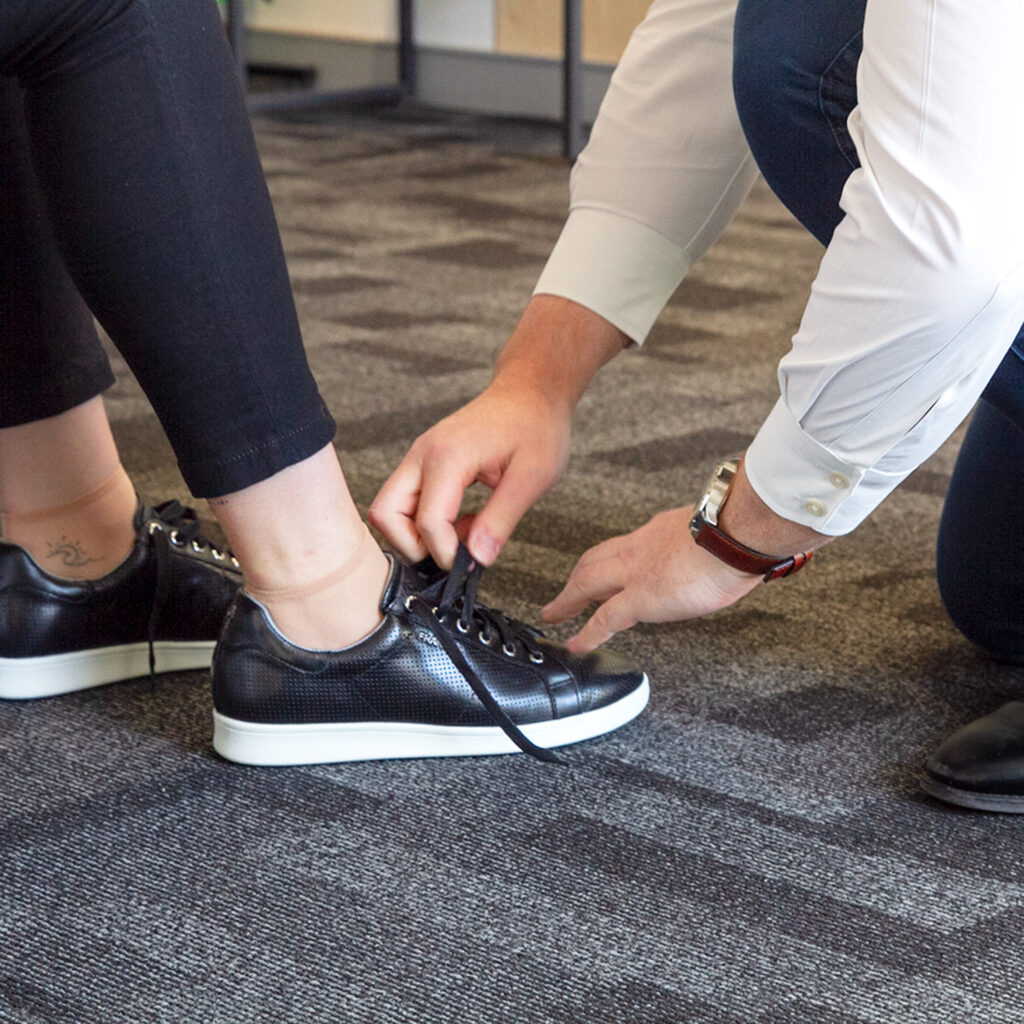
A footwear assessment is a podiatry appointment that checks whether your shoes match your feet, your activity and any symptoms you have. Your podiatrist looks at the shoes you already wear, how they fit, and where they have worn down.
Shoes will not solve every foot problem on their own. They change how pressure and load move through your feet, which is why footwear is one of the first things your podiatrist checks.
Who does it affect?
anyone with foot pain, rubbing or pressure, plus workers on their feet, runners, older adults and people with diabetes
How common is it?
footwear is one of the most common contributing factors found in everyday foot complaints
What is the recovery like?
comfort often changes quickly once footwear is corrected, though this varies from person to person
Who should I see for treatment?
your podiatrist
What funding options are available?
Medicare, NDIS, DVA and private health funds accepted
What is a footwear assessment?
A footwear assessment is a structured check of your shoes against your feet. Your podiatrist measures your feet, examines the shoes you wear most, and matches the two to your activity, your job and any pain you have.
Footwear problems build up quietly. A shoe that is slightly short or narrow feels tolerable at first, then produces a callus, a bruised nail or forefoot pain months later. Worn shoes do the same thing in reverse, losing support so gradually that you never notice the day they stopped working.
Common contributing factors include:
Shoes that are too short or too narrow across the toes
Midsoles and tread that have worn unevenly or flattened out
Shoes that bend through the middle instead of at the toes
Footwear that does not suit the surface or the activity
Slip-on styles with no laces, straps or fastening
A sudden change in shoe type, drop or heel height
Symptoms of Footwear assessment
Pain that eases in one pair of shoes and returns in another
Corns, calluses or blisters that keep forming in the same spot
Toenails that bruise, thicken or lift after long walks or runs
Rubbing at the heel, across the top of the foot or at the little toe
Toes that feel cramped, hot or numb by the end of the day
Heel or arch pain that starts within days of a new pair
Your podiatrist builds your recommendations from what the assessment finds, so the advice suits your feet, your budget and where you actually spend your day.
What to expect at your first appointment
Tell us what is going on
Describe where it hurts, when it started, what you wear at work and what you do for exercise.
A full assessment
Your podiatrist measures both feet, checks joint motion and skin, and examines the shoes you bring in.
A clear plan
You leave knowing which shoes to keep, which to retire and exactly what features to look for next.
Review and adjust
A follow-up checks how the new footwear is performing and whether modifications or other treatment would help.

When to book an appointment
Foot pain has lasted more than two weeks and changes with the shoes you wear
Rubbing, blisters or calluses are stopping you working, walking or training
You have already changed shoes or added insoles and nothing improved
You are not sure what to buy and keep wasting money on the wrong pair
Looking after yourself at home
These habits help most people between appointments, and they cost nothing.
Shoes that are too short or too narrow across the toes
Midsoles and tread that have worn unevenly or flattened out
Shoes that bend through the middle instead of at the toes
Footwear that does not suit the surface or the activity
Slip-on styles with no laces, straps or fastening
A sudden change in shoe type, drop or heel height

Meet the team who treat this
Behind every appointment is a team of practitioners who know each other, trust each other and work together for you. Across seven clinics and nine disciplines, our team shares expertise, coordinates treatment plans and celebrates your progress together.

Aimee Fuller
Healthcare Support Officer
Available at Blaxland

Alicia Whiticker
Healthcare Support Officer
Available at Blaxland

Amanda Banks
Healthcare Support Officer
Available at Blaxland

Amanda Duggan
Healthcare Support Officer
Available at Blaxland

Amy Meekings
Healthcare Support Officer
Available at Blaxland

Anita Beerapu
Healthcare Support Officer
Available at Blaxland

Benjamin Tucker
Healthcare Support Officer
Available at Blaxland

Blake Cossar
Healthcare Support Officer
Available at Blaxland

Bronte Tupper
Healthcare Support Officer
Available at Blaxland

Chris Farrugia
Healthcare Support Officer
Available at Blaxland

Corrina Aitken
Healthcare Support Officer
Available at Blaxland

David Logue
Healthcare Support Officer
Available at Blaxland

Dean Gresser
Healthcare Support Officer
Available at Blaxland

Emma Nassif
Healthcare Support Officer
Available at Blaxland

Esha Sharma
Healthcare Support Officer
Available at Blaxland

Fatima Hussaini
Healthcare Support Officer
Available at Blaxland

Felicity Spencer-Davey
Healthcare Support Officer
Available at Blaxland

Frankie Raikadroka
Healthcare Support Officer
Available at Blaxland

Hannah Norrie
Healthcare Support Officer
Available at Blaxland

Heather Edwards
Healthcare Support Officer
Available at Blaxland

Isaac Vella
Healthcare Support Officer
Available at Blaxland

Jarrah Nesbitt
Healthcare Support Officer
Available at Blaxland

Jonathan Lopez
Healthcare Support Officer
Available at Blaxland

Justin Hanna
Healthcare Support Officer
Available at Blaxland

Kasey Collins
Healthcare Support Officer
Available at Blaxland

Katrina Gauci
Healthcare Support Officer
Available at Blaxland

Kennedy Touet
Healthcare Support Officer
Available at Blaxland

Kristy Edwards
Healthcare Support Officer
Available at Blaxland

Kyle Perry
Healthcare Support Officer
Available at Blaxland

Lorna Nicastri
Healthcare Support Officer
Available at Blaxland

Maja Bosic
Healthcare Support Officer
Available at Blaxland

Marxy Koronel
Healthcare Support Officer
Available at Blaxland

Matt Barton
Healthcare Support Officer
Available at Blaxland

Michael Todd
Healthcare Support Officer
Available at Blaxland

Mr Jeffery Jenkins FACPS
Healthcare Support Officer
Available at Blaxland

Nathan Cavanagh
Healthcare Support Officer
Available at Blaxland

Patrick Celeban
Healthcare Support Officer
Available at Blaxland

Praise Khin
Healthcare Support Officer
Available at Blaxland

Sarah Bonnici
Healthcare Support Officer
Available at Blaxland

Shannon Smith
Healthcare Support Officer
Available at Blaxland

Siobhan Kelly
Healthcare Support Officer
Available at Blaxland

Taleisha Bozzi
Healthcare Support Officer
Available at Blaxland

Trystan Singh
Healthcare Support Officer
Available at Blaxland

Uty Kotwal
Healthcare Support Officer
Available at Blaxland

Yoni Hochberg
Healthcare Support Officer
Available at Blaxland

Zak Lloyd
Healthcare Support Officer
Available at Blaxland
EPC, DVA, NDIS and WorkCover welcome
Nearly half of our appointments are funded through Medicare, DVA, NDIS or WorkCover. We manage the paperwork so you can focus on your health.


NDIS
We support eligible NDIS participants across podiatry, physiotherapy, exercise physiology, dietetics and psychology, depending on your plan and goals. Eligibility and funding are set by your plan.

Medicare
Medicare may rebate podiatry, physiotherapy, exercise physiology and dietetics sessions when your GP refers you under an Enhanced Primary Care (EPC) or Chronic Disease Management (CDM) plan, and psychology sessions under a Mental Health Care Plan. The number of sessions is set by your plan.

DVA
Gold and White card holders can access DVA-funded care across our services with a valid referral.

WorkCover
If you have been injured at work, we accept WorkCover referrals for physiotherapy, exercise physiology and psychology, and manage the paperwork with your insurer, with a clear return-to-work plan.
Seven clinics across three regions
Find a clinic near you. Each location is staffed by local practitioners who know your community.
Penrith
Western SydneyOur largest centre, with our full range of services under one roof.
Ropes Crossing
Western SydneyPodiatry, at Ropes Crossing Village.
Blaxland
Blue MountainsPodiatry, physiotherapy, exercise physiology and group classes.
Springwood
Blue MountainsPodiatry, dietetics and a boutique footwear store.
Katoomba
Blue MountainsPodiatry, physiotherapy and dietetics, in a restored 1914 cottage.
Ryde
North ShorePodiatry, physiotherapy, dietetics and exercise physiology, with a footwear store and gait analysis.
Lindfield
North ShorePodiatry, with mobile podiatry across the North Shore and Northern Beaches.
Ready to find out if your shoes are the problem?
Bring in the shoes you wear most and get clear, specific advice on what to buy next.















Frequently asked questions
How often should I replace my shoes?
Most walking and running shoes need replacing between 500 and 800 kilometres, which is roughly six to twelve months for a regular walker. Time matters as much as distance, because midsole foam compresses and hardens with age even in shoes that sit in a cupboard. Check the creasing in the midsole and whether the tread has flattened under the ball and heel.
Are more expensive shoes better for my feet?
No. Price mostly buys materials, cushioning technology and branding, not fit. A cheaper shoe in the correct length, width and depth will usually feel better than an expensive shoe that squeezes your toes. What matters is toe room, heel hold, a secure fastening and a flex point that matches where your foot bends. Fit first, features second.
Are barefoot or minimalist shoes bad for my feet?
Not automatically, but they change the load. Minimalist shoes reduce cushioning and heel height, which shifts work onto your calf, Achilles and forefoot. Some people tolerate that well, while others develop pain when they switch quickly. If you want to try them, build up over several weeks and keep your existing shoes for long days and high-mileage sessions.
Can you assess work boots, safety footwear or a uniform shoe?
Yes. Bring the boots or shoes your workplace requires, along with the socks you wear with them. Your podiatrist can check fit, depth, toe cap clearance and lacing, and suggest modifications such as different insoles, lacing patterns or a heel raise. Where the standard issue does not fit, you may be able to request an alternative compliant model through your employer.
How much room should there be at the end of a shoe?
Around one thumb width, or roughly ten to fifteen millimetres, between your longest toe and the end of the shoe when you are standing. Your longest toe is not always your big toe. Feet also lengthen and spread under body weight, so measure standing rather than sitting, and always fit to the larger foot.
Can my footwear be modified instead of replaced?
Often, yes. A shoe that fits in length and width but causes pressure in one area can sometimes be adapted with a stretched toe box, a rocker sole, a heel raise or a different insole. Modification works best when the shoe is structurally sound. Worn midsoles, broken heel counters and split uppers are not worth adapting.