

Fungal nail treatment
Get on top of thick, yellow, crumbling toenails
Your toenail has turned yellow and thick, it catches in your socks, and the paint from the chemist has done nothing. Fungal nail infections are stubborn, but they respond to treatment.
Medicare, NDIS, DVA and private health funds accepted.
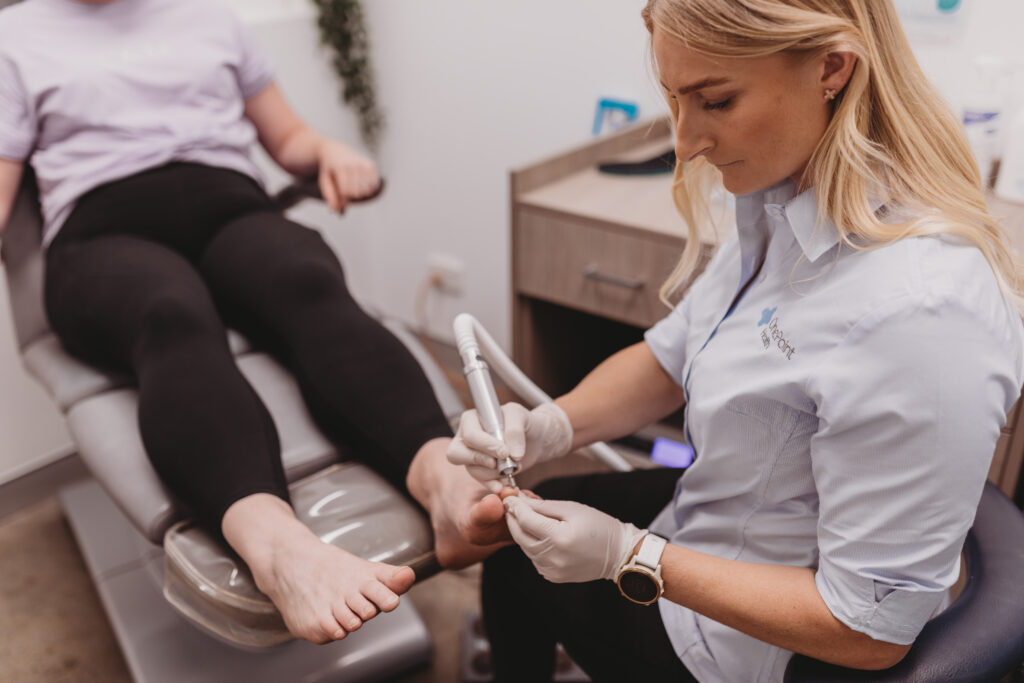
Understanding Fungal nail treatment
A fungal nail infection, or onychomycosis, is a fungal infection inside the nail itself. It makes the nail thick, yellow or white, brittle and sometimes painful in shoes. It rarely clears up on its own, because the fungus sits under and inside the nail plate where creams struggle to reach.
Treatment works best when the infection is confirmed first, the thickened nail is reduced so medication can get in, and the source of the fungus is dealt with at the same time. Your podiatrist can do all three, and can work with your GP if tablets are worth considering.
Who does it affect?
adults of any age, and more often if you have diabetes, reduced circulation, a suppressed immune system or a history of nail trauma
How common is it?
one of the most common nail problems seen in podiatry, and more common with age
What is the recovery like?
toenails grow slowly, so visible change takes months and varies from person to person
Who should I see for treatment?
your podiatrist, alongside your GP if oral antifungal medication is being considered
What funding options are available?
Medicare, NDIS, DVA and private health funds accepted
What is a fungal nail infection?
A fungal nail infection happens when fungi get into the nail plate and the nail bed underneath. The same fungi that cause tinea on the skin are usually responsible, which is why fungal nails and flaky, itchy skin between the toes often turn up together.
It normally starts as a small white or yellow patch at the tip or side of one nail. Over weeks and months the fungus spreads towards the base, the nail thickens, and the nail can lift away from the nail bed. Once it is established, it can pass to your other toes.
Things that make an infection more likely include:
A small crack or lift in the nail from stubbing it, dropping something on it, or pressure from tight shoes
Warm, damp feet inside enclosed shoes and sweaty socks for long stretches of the day
Shared wet floors such as pools, gyms, showers and change rooms
Untreated Tinea (Athletes Foot) on the soles of your feet or between your toes, which can move to your toe nails.
Diabetes, poor circulation or medication that lowers your immune response
Nail tools that have not been properly cleaned between people
Symptoms of Fungal nail treatment
A fungal nail usually looks and feels different from the nail beside it. Common signs include:
Yellow, white, brown or streaky discolouration through the nail
Thickening, so the nail no longer fits comfortably under a sock or shoe
Crumbly or powdery edges that break off when cut
The nail lifting away from the nail bed, with debris building up underneath
A change in nail shape, or ridges and pitting across the surface
Pressure pain or tenderness when you press on the nail or wear enclosed shoes
Your treatment plan starts with a proper look at the nail, not a guess
What to expect at your first appointment
Tell us what is going on
How long the nail has looked like this, whether you have injured it, what you have already tried, and whether it hurts in shoes.
A full assessment
Your podiatrist examines all your nails and the skin between your toes, checks your circulation and sensation, and may take a nail sample for testing.
A clear plan
You will hear what is causing the change, which treatment options suit your nail and your health history, and what a realistic timeline looks like.
Review and adjust
Nails grow slowly, so you will come back for nail reduction and progress checks, and the plan is adjusted as new nail comes through.

When to book an appointment
A nail has been thick or discoloured for more than three months and is not improving
The nail hurts in shoes, catches on socks, or makes walking or running uncomfortable
You have used a chemist antifungal paint for several weeks with no visible change
You are not sure whether the nail is infected, injured or something else
Book an assessment if:
Looking after yourself at home
Alongside treatment, a few daily habits reduce the chance of the fungus spreading or coming back:
A small crack or lift in the nail from stubbing it, dropping something on it, or pressure from tight shoes
Warm, damp feet inside enclosed shoes and sweaty socks for long stretches of the day
Shared wet floors such as pools, gyms, showers and change rooms
Untreated Tinea (Athletes Foot) on the soles of your feet or between your toes, which can move to your toe nails.
Diabetes, poor circulation or medication that lowers your immune response
Nail tools that have not been properly cleaned between people

Meet the team who treat this
Behind every appointment is a team of practitioners who know each other, trust each other and work together for you. Across seven clinics and nine disciplines, our team shares expertise, coordinates treatment plans and celebrates your progress together.

Aimee Fuller
Healthcare Support Officer
Available at Blaxland

Alicia Whiticker
Healthcare Support Officer
Available at Blaxland

Amanda Banks
Healthcare Support Officer
Available at Blaxland

Amanda Duggan
Healthcare Support Officer
Available at Blaxland

Amy Meekings
Healthcare Support Officer
Available at Blaxland

Anita Beerapu
Healthcare Support Officer
Available at Blaxland

Benjamin Tucker
Healthcare Support Officer
Available at Blaxland

Blake Cossar
Healthcare Support Officer
Available at Blaxland

Bronte Tupper
Healthcare Support Officer
Available at Blaxland

Chris Farrugia
Healthcare Support Officer
Available at Blaxland

Corrina Aitken
Healthcare Support Officer
Available at Blaxland

David Logue
Healthcare Support Officer
Available at Blaxland

Dean Gresser
Healthcare Support Officer
Available at Blaxland

Emma Nassif
Healthcare Support Officer
Available at Blaxland

Esha Sharma
Healthcare Support Officer
Available at Blaxland

Fatima Hussaini
Healthcare Support Officer
Available at Blaxland

Felicity Spencer-Davey
Healthcare Support Officer
Available at Blaxland

Frankie Raikadroka
Healthcare Support Officer
Available at Blaxland

Hannah Norrie
Healthcare Support Officer
Available at Blaxland

Heather Edwards
Healthcare Support Officer
Available at Blaxland

Isaac Vella
Healthcare Support Officer
Available at Blaxland

Jarrah Nesbitt
Healthcare Support Officer
Available at Blaxland

Jonathan Lopez
Healthcare Support Officer
Available at Blaxland

Justin Hanna
Healthcare Support Officer
Available at Blaxland

Kasey Collins
Healthcare Support Officer
Available at Blaxland

Katrina Gauci
Healthcare Support Officer
Available at Blaxland

Kennedy Touet
Healthcare Support Officer
Available at Blaxland

Kristy Edwards
Healthcare Support Officer
Available at Blaxland

Kyle Perry
Healthcare Support Officer
Available at Blaxland

Lorna Nicastri
Healthcare Support Officer
Available at Blaxland

Maja Bosic
Healthcare Support Officer
Available at Blaxland

Marxy Koronel
Healthcare Support Officer
Available at Blaxland

Matt Barton
Healthcare Support Officer
Available at Blaxland

Michael Todd
Healthcare Support Officer
Available at Blaxland

Mr Jeffery Jenkins FACPS
Healthcare Support Officer
Available at Blaxland

Nathan Cavanagh
Healthcare Support Officer
Available at Blaxland

Patrick Celeban
Healthcare Support Officer
Available at Blaxland

Praise Khin
Healthcare Support Officer
Available at Blaxland

Sarah Bonnici
Healthcare Support Officer
Available at Blaxland

Shannon Smith
Healthcare Support Officer
Available at Blaxland

Siobhan Kelly
Healthcare Support Officer
Available at Blaxland

Taleisha Bozzi
Healthcare Support Officer
Available at Blaxland

Trystan Singh
Healthcare Support Officer
Available at Blaxland

Uty Kotwal
Healthcare Support Officer
Available at Blaxland

Yoni Hochberg
Healthcare Support Officer
Available at Blaxland

Zak Lloyd
Healthcare Support Officer
Available at Blaxland
EPC, DVA, NDIS and WorkCover welcome
Nearly half of our appointments are funded through Medicare, DVA, NDIS or WorkCover. We manage the paperwork so you can focus on your health.


NDIS
We support eligible NDIS participants across podiatry, physiotherapy, exercise physiology, dietetics and psychology, depending on your plan and goals. Eligibility and funding are set by your plan.

Medicare
Medicare may rebate podiatry, physiotherapy, exercise physiology and dietetics sessions when your GP refers you under an Enhanced Primary Care (EPC) or Chronic Disease Management (CDM) plan, and psychology sessions under a Mental Health Care Plan. The number of sessions is set by your plan.

DVA
Gold and White card holders can access DVA-funded care across our services with a valid referral.

WorkCover
If you have been injured at work, we accept WorkCover referrals for physiotherapy, exercise physiology and psychology, and manage the paperwork with your insurer, with a clear return-to-work plan.
Seven clinics across three regions
Find a clinic near you. Each location is staffed by local practitioners who know your community.
Penrith
Western SydneyOur largest centre, with our full range of services under one roof.
Ropes Crossing
Western SydneyPodiatry, at Ropes Crossing Village.
Blaxland
Blue MountainsPodiatry, physiotherapy, exercise physiology and group classes.
Springwood
Blue MountainsPodiatry, dietetics and a boutique footwear store.
Katoomba
Blue MountainsPodiatry, physiotherapy and dietetics, in a restored 1914 cottage.
Ryde
North ShorePodiatry, physiotherapy, dietetics and exercise physiology, with a footwear store and gait analysis.
Lindfield
North ShorePodiatry, with mobile podiatry across the North Shore and Northern Beaches.
Ready to sort out that toenail?
Book a podiatry assessment, find out what is really going on, and start treatment.
















Frequently asked questions
Are fungal nail infections contagious?
Yes. The fungus can pass from one nail to another, from your skin to your nails, and between people through shared wet floors, towels, bath mats and nail tools. It does not spread through casual contact, so you do not need to isolate anything. Keeping your own clippers, wearing thongs in shared showers and washing towels and bath mats regularly makes a real difference at home.
Does laser treatment work for fungal nails?
Laser devices heat the nail to reduce fungal growth, and research shows mixed results, with improvement in nail appearance more common than complete clearance. Most evidence supports laser as one part of a plan that also includes nail reduction and antifungal treatment, rather than a standalone fix. [CONFIRM: whether laser nail therapy is offered at OnePointHealth, and at which locations.]
Can I wear nail polish over a fungal nail?
It is better to leave the nail bare during treatment. Polish traps moisture against the nail plate, hides the changes your podiatrist is tracking, and blocks medicated lacquers from getting through. Acetone removers also dry and weaken the nail. If you have an event coming up, ask about timing so you can plan a polish-free window around it.
Will my nail look normal again once the infection clears?
Often, but not always. A toenail takes roughly 12 to 18 months to grow out fully, so appearance improves gradually from the base. If the infection has been present for years, or the nail-growing area has been damaged by injury, the new nail can grow back with permanent ridges, thickening or shape changes even after the fungus has gone.
Can children get fungal nail infections?
They can, but it is uncommon. In children, a thick or discoloured nail is more often caused by trauma, footwear pressure or a skin condition, so testing before starting antifungal treatment is worthwhile. Children’s nails also grow faster than adults’ nails, which can work in their favour. Teenagers in sports shoes and shared change rooms are the group most likely to be affected.
Can I still use the pool, gym and public showers during treatment?
Yes, you can keep training and swimming. Cover the nail if you prefer, wear thongs on wet floors, and dry your feet and between your toes thoroughly before putting socks on. Take a separate pair of socks for after training, and let gym shoes air out rather than leaving them sealed in a bag. Stopping activity is not necessary.