

Gait analysis
Find out exactly how you walk, run and load your body
You have been told your feet roll in, or that your running form is the problem, but nobody has shown you what is actually happening. A gait analysis measures how you move, so your treatment targets the cause instead of the symptom.
Medicare, NDIS, DVA and private health funds accepted.
Understanding Gait analysis
Gait analysis is a detailed look at how you walk and run. Your podiatrist or physiotherapist watches you move, measures joint range, strength and foot position, then links what they find to the pain or performance problem you came in with.
You may also hear it called a biomechanical assessment. The result is not a report you file away. It is a plan with specific steps, which may include strength work, footwear changes, load management or orthotics.
Who does it affect?
anyone with recurring lower limb pain, including runners, walkers, people on their feet all day, and growing children.
How common is it?
gait assessment is a routine part of podiatry and physiotherapy care for foot, ankle, knee, hip and lower back pain.
What is the recovery like?
varies. Some problems settle within weeks of a change in load or footwear; others need months of graded strengthening.
Who should I see for treatment?
podiatrists and physiotherapists, often working together.
What funding options are available?
Medicare, NDIS, DVA and private health funds accepted.
What is gait analysis?
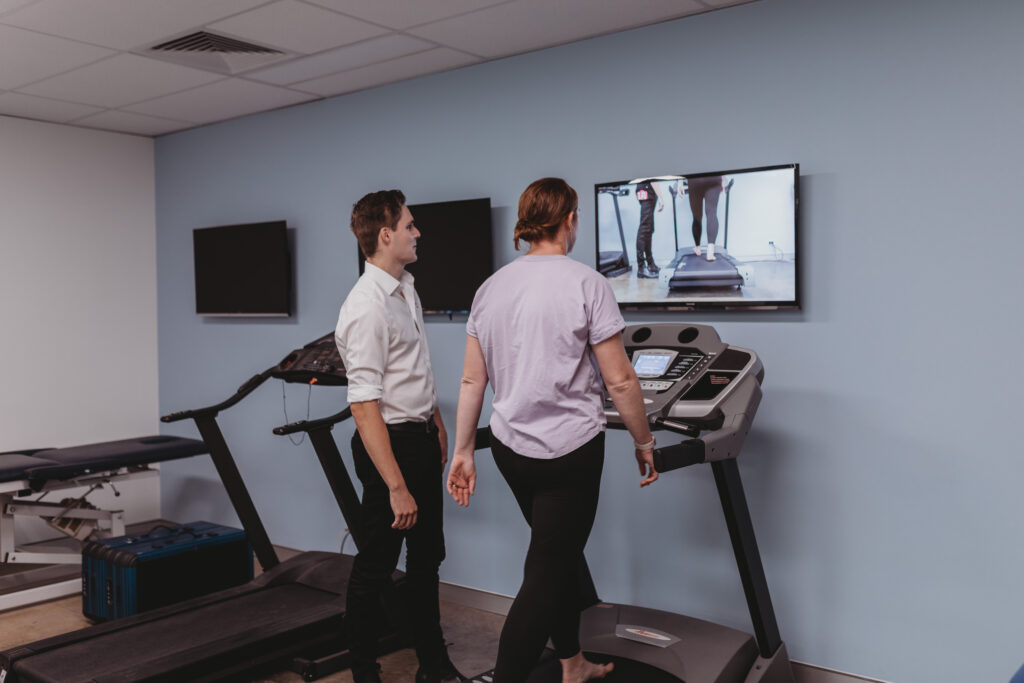
Gait analysis is the assessment of how your body moves through a walking or running cycle. Your podiatrist or physiotherapist looks at your foot position, knee and hip control, stride, cadence and timing, usually on a treadmill and on the floor, and often on video that can be slowed down and replayed.
Problems rarely start with one dramatic moment. Small differences in strength, joint range or foot mechanics change how force travels through your leg with every step. Over thousands of steps, one structure ends up taking more load than it can handle, and that is where the pain shows up.
Things that commonly influence your gait include:
Foot structure, including a flatter or higher arch and the way your foot rolls in or out
Restricted ankle, knee or hip range of motion
Weakness or poor control through your calf, glutes and core
A jump in training volume, speed, hills or hours on your feet
Footwear that no longer suits your foot or your activity
Previous injuries, surgery or a period of reduced activity
Symptoms of Gait analysis
Signs that your gait may be contributing to your problem:
Pain that returns in the same spot every time you build up distance or hours
Pain on one side only, with no clear injury behind it
Uneven or unusual wear patterns on the soles of your shoes
Pain that moves up the chain, from foot to knee, hip or lower back
Feeling unstable, clumsy or prone to rolling an ankle
Treatment that helped for a few weeks, then the same pain came back
Your plan comes from your assessment, not a template
What to expect at your first appointment
Tell us what is going on
You explain your pain, your goals, your training or work demands, and what you have already tried.
A full assessment
Your podiatrist or physiotherapist tests strength, joint range and foot position, then records you walking and running.
A clear plan
You see your own footage, and you leave knowing what is driving the problem and what happens next.
Review and adjust
You come back so progress can be measured, and the plan is changed as your movement changes.
When to book an appointment
Pain has lasted more than four weeks, or keeps returning every time you increase activity
You are cutting runs short, changing shifts or avoiding stairs and hills
Rest, stretching and new shoes have not held the problem
You have been told you overpronate or have poor form, but not what to do about it
Book an assessment if:
Looking after yourself at home
These steps help most people while you wait for your appointment.
Foot structure, including a flatter or higher arch and the way your foot rolls in or out
Restricted ankle, knee or hip range of motion
Weakness or poor control through your calf, glutes and core
A jump in training volume, speed, hills or hours on your feet
Footwear that no longer suits your foot or your activity
Previous injuries, surgery or a period of reduced activity

Meet the team who treat this
Behind every appointment is a team of practitioners who know each other, trust each other and work together for you. Across seven clinics and nine disciplines, our team shares expertise, coordinates treatment plans and celebrates your progress together.

Aimee Fuller
Healthcare Support Officer
Available at Blaxland

Alicia Whiticker
Healthcare Support Officer
Available at Blaxland

Amanda Banks
Healthcare Support Officer
Available at Blaxland

Amanda Duggan
Healthcare Support Officer
Available at Blaxland

Amy Meekings
Healthcare Support Officer
Available at Blaxland

Anita Beerapu
Healthcare Support Officer
Available at Blaxland

Benjamin Tucker
Healthcare Support Officer
Available at Blaxland

Blake Cossar
Healthcare Support Officer
Available at Blaxland

Bronte Tupper
Healthcare Support Officer
Available at Blaxland

Chris Farrugia
Healthcare Support Officer
Available at Blaxland

Corrina Aitken
Healthcare Support Officer
Available at Blaxland

David Logue
Healthcare Support Officer
Available at Blaxland

Dean Gresser
Healthcare Support Officer
Available at Blaxland

Emma Nassif
Healthcare Support Officer
Available at Blaxland

Esha Sharma
Healthcare Support Officer
Available at Blaxland

Fatima Hussaini
Healthcare Support Officer
Available at Blaxland

Felicity Spencer-Davey
Healthcare Support Officer
Available at Blaxland

Frankie Raikadroka
Healthcare Support Officer
Available at Blaxland

Hannah Norrie
Healthcare Support Officer
Available at Blaxland

Heather Edwards
Healthcare Support Officer
Available at Blaxland

Isaac Vella
Healthcare Support Officer
Available at Blaxland

Jarrah Nesbitt
Healthcare Support Officer
Available at Blaxland

Jonathan Lopez
Healthcare Support Officer
Available at Blaxland

Justin Hanna
Healthcare Support Officer
Available at Blaxland

Kasey Collins
Healthcare Support Officer
Available at Blaxland

Katrina Gauci
Healthcare Support Officer
Available at Blaxland

Kennedy Touet
Healthcare Support Officer
Available at Blaxland

Kristy Edwards
Healthcare Support Officer
Available at Blaxland

Kyle Perry
Healthcare Support Officer
Available at Blaxland

Lorna Nicastri
Healthcare Support Officer
Available at Blaxland

Maja Bosic
Healthcare Support Officer
Available at Blaxland

Marxy Koronel
Healthcare Support Officer
Available at Blaxland

Matt Barton
Healthcare Support Officer
Available at Blaxland

Michael Todd
Healthcare Support Officer
Available at Blaxland

Mr Jeffery Jenkins FACPS
Healthcare Support Officer
Available at Blaxland

Nathan Cavanagh
Healthcare Support Officer
Available at Blaxland

Patrick Celeban
Healthcare Support Officer
Available at Blaxland

Praise Khin
Healthcare Support Officer
Available at Blaxland

Sarah Bonnici
Healthcare Support Officer
Available at Blaxland

Shannon Smith
Healthcare Support Officer
Available at Blaxland

Siobhan Kelly
Healthcare Support Officer
Available at Blaxland

Taleisha Bozzi
Healthcare Support Officer
Available at Blaxland

Trystan Singh
Healthcare Support Officer
Available at Blaxland

Uty Kotwal
Healthcare Support Officer
Available at Blaxland

Yoni Hochberg
Healthcare Support Officer
Available at Blaxland

Zak Lloyd
Healthcare Support Officer
Available at Blaxland
EPC, DVA, NDIS and WorkCover welcome
Nearly half of our appointments are funded through Medicare, DVA, NDIS or WorkCover. We manage the paperwork so you can focus on your health.


NDIS
We support eligible NDIS participants across podiatry, physiotherapy, exercise physiology, dietetics and psychology, depending on your plan and goals. Eligibility and funding are set by your plan.

Medicare
Medicare may rebate podiatry, physiotherapy, exercise physiology and dietetics sessions when your GP refers you under an Enhanced Primary Care (EPC) or Chronic Disease Management (CDM) plan, and psychology sessions under a Mental Health Care Plan. The number of sessions is set by your plan.

DVA
Gold and White card holders can access DVA-funded care across our services with a valid referral.

WorkCover
If you have been injured at work, we accept WorkCover referrals for physiotherapy, exercise physiology and psychology, and manage the paperwork with your insurer, with a clear return-to-work plan.
Seven clinics across three regions
Find a clinic near you. Each location is staffed by local practitioners who know your community.
Penrith
Western SydneyOur largest centre, with our full range of services under one roof.
Ropes Crossing
Western SydneyPodiatry, at Ropes Crossing Village.
Blaxland
Blue MountainsPodiatry, physiotherapy, exercise physiology and group classes.
Springwood
Blue MountainsPodiatry, dietetics and a boutique footwear store.
Katoomba
Blue MountainsPodiatry, physiotherapy and dietetics, in a restored 1914 cottage.
Ryde
North ShorePodiatry, physiotherapy, dietetics and exercise physiology, with a footwear store and gait analysis.
Lindfield
North ShorePodiatry, with mobile podiatry across the North Shore and Northern Beaches.
Ready to see what your gait is really doing?
Book a gait analysis and get a plan built on your own movement, not guesswork.
















Frequently asked questions
Is gait analysis the same as a biomechanical assessment?
They overlap, and at OnePointHealth they are booked as the same appointment. A biomechanical assessment measures your body at rest: joint range, strength, alignment and foot structure. Gait analysis adds the moving picture, showing how those measurements behave under load when you walk or run. One without the other gives half the story, so your podiatrist or physiotherapist does both in the same visit.
How long does the appointment take?
Allow around 45 to 60 minutes for a first gait analysis appointment. [CONFIRM: standard appointment duration and any extended booking option]. That time covers your history, physical testing, walking and running capture, and a review of your footage with your podiatrist or physiotherapist. Follow-up reviews are usually shorter, because the baseline measurements already exist and only the changes need retesting.
What should I wear and bring?
Bring shorts or loose clothing that lets your knees be seen, plus the shoes you actually train, work or walk in. Worn shoes are useful evidence, so bring old pairs as well as new ones. If you use orthotics, bring those too, including devices made elsewhere. If you have recent scans or a GP referral, bring them along.
Will I definitely need orthotics afterwards?
No. Orthotics are one option among several, and many people leave with a strength program, a footwear change or a training adjustment instead. Your podiatrist recommends a device when your assessment shows foot position or pressure distribution is a significant part of the problem. Where orthotics are recommended, they usually sit alongside exercise rather than replacing it.
Can I have a gait analysis if I am not in pain?
Yes. People book without pain for several reasons: returning to running after a break, preparing for an event, choosing new shoes, or checking a child’s walking pattern. A baseline is also useful if you have a history of injuries on one side. Your practitioner will tell you honestly if nothing needs changing.
Do you use video or a treadmill?
Both. Treadmill running allows a steady, repeatable pattern that can be filmed from behind and side on, then slowed down frame by frame. Floor walking is also assessed, because treadmill and overground movement differ slightly. [CONFIRM: pressure plate, force plate or 3D motion capture technology available by clinic]. You see your own footage during the appointment, not just a written summary.