

Golfer's elbow
Get the inside of your elbow working again
The inside of your elbow aches every time you grip a club, a bag or a drill, and your forearm feels weak by the end of the day. Golfer’s elbow is a tendon problem, and tendons respond well to the right loading plan.
Medicare, NDIS, DVA and private health funds accepted.
Understanding Golfer’s elbow
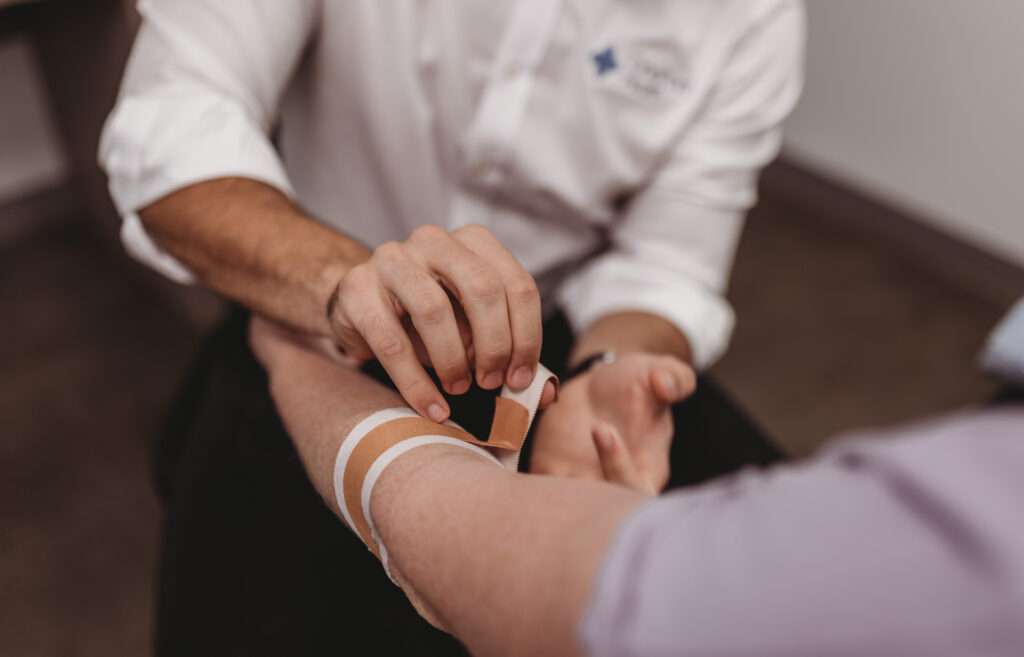
Golfer’s elbow is pain on the inside of your elbow, where the forearm muscles that bend your wrist and fingers attach to a bony bump called the medial epicondyle. It develops when gripping, lifting or swinging loads that tendon faster than it can repair itself.
You do not have to play golf to get it. Treatment settles the pain first, then rebuilds the tendon so grip, lifting and sport stop provoking it.
Who does it affect?
adults between 30 and 60, tradespeople, gym lifters, throwers, and racquet and club sports players.
How common is it?
less common than tennis elbow, which affects the outside of the elbow.
What is the recovery like?
varies from person to person, and tendon programs are usually measured in months rather than days.
Who should I see for treatment?
your physiotherapist.
What funding options are available?
Medicare, NDIS, DVA and private health funds accepted.
What is golfers elbow?
Golfer’s elbow, also called medial epicondylalgia, is a tendinopathy: a tendon that has been overloaded and has lost some of its capacity to handle force. The tendons involved run from the inside of your elbow down into your wrist and fingers, so anything that grips or bends the wrist pulls on them.
It usually builds slowly. You notice a niggle after a big day of work or a long session at the range, it eases overnight, then it starts turning up earlier and lasting longer. Sudden onset after one heavy lift or awkward catch is less common but does happen.
Things that commonly contribute:
A jump in gripping load: new tools, more reps, heavier weights, extra rounds of golf.
Technique and equipment: grip size, club or racquet weight, throwing mechanics, bar and handle thickness.
Weakness further up the chain, especially in the shoulder blade and rotator cuff, which makes the forearm work harder.
Reduced wrist and forearm flexibility, or previous elbow injury on the same side.
Symptoms of Golfer’s elbow
Pain on the inside of the elbow, often tender to press on the bony point.
Pain when you grip, twist a lid, shake hands or carry shopping.
Ache spreading down the inside of the forearm towards the wrist.
Stiffness in the elbow first thing in the morning that eases with movement.
Weaker grip, or dropping things you would normally hold easily.
Pain when you straighten your elbow fully after it has been bent for a while.
Your treatment plan comes out of the assessment, because two people with inner elbow pain rarely need the same thing.
What to expect at your first appointment
Tell us what is going on
When it started, what makes it worse, what you need your arm to do at work, in the gym and on the course.
A full assessment
Your physiotherapist tests grip strength, wrist and elbow movement, tendon loading, nerve symptoms, and your neck and shoulder.
A clear plan
You leave knowing what the diagnosis is, what your first exercises are, and what to change this week.
Review and adjust
We track grip strength and pain response, then progress the load as the tendon tolerates more.
When to book an appointment
You’re experiencing inner elbow pain that isn’t improving with activity modification, is affecting your daily activities or sport, or is getting worse.
Your grip is failing at work, in the gym or on the golf course.
Rest, ice and anti-inflammatory gels have not changed anything.
You are not sure whether this is a tendon, a nerve or something coming from your neck.
Book an assessment if:
Looking after yourself at home
These help most people with golfer’s elbow, alongside a plan from your physiotherapist.
A jump in gripping load: new tools, more reps, heavier weights, extra rounds of golf.
Technique and equipment: grip size, club or racquet weight, throwing mechanics, bar and handle thickness.
Weakness further up the chain, especially in the shoulder blade and rotator cuff, which makes the forearm work harder.
Reduced wrist and forearm flexibility, or previous elbow injury on the same side.

Meet the team who treat this
Behind every appointment is a team of practitioners who know each other, trust each other and work together for you. Across seven clinics and nine disciplines, our team shares expertise, coordinates treatment plans and celebrates your progress together.

Aimee Fuller
Healthcare Support Officer
Available at Blaxland

Alicia Whiticker
Healthcare Support Officer
Available at Blaxland

Amanda Banks
Healthcare Support Officer
Available at Blaxland

Amanda Duggan
Healthcare Support Officer
Available at Blaxland

Amy Meekings
Healthcare Support Officer
Available at Blaxland

Anita Beerapu
Healthcare Support Officer
Available at Blaxland

Benjamin Tucker
Healthcare Support Officer
Available at Blaxland

Blake Cossar
Healthcare Support Officer
Available at Blaxland

Bronte Tupper
Healthcare Support Officer
Available at Blaxland

Chris Farrugia
Healthcare Support Officer
Available at Blaxland

Corrina Aitken
Healthcare Support Officer
Available at Blaxland

David Logue
Healthcare Support Officer
Available at Blaxland

Dean Gresser
Healthcare Support Officer
Available at Blaxland

Emma Nassif
Healthcare Support Officer
Available at Blaxland

Esha Sharma
Healthcare Support Officer
Available at Blaxland

Fatima Hussaini
Healthcare Support Officer
Available at Blaxland

Felicity Spencer-Davey
Healthcare Support Officer
Available at Blaxland

Frankie Raikadroka
Healthcare Support Officer
Available at Blaxland
Hannah Norrie
Healthcare Support Officer
Available at Blaxland

Heather Edwards
Healthcare Support Officer
Available at Blaxland

Isaac Vella
Healthcare Support Officer
Available at Blaxland

Jarrah Nesbitt
Healthcare Support Officer
Available at Blaxland

Jonathan Lopez
Healthcare Support Officer
Available at Blaxland

Justin Hanna
Healthcare Support Officer
Available at Blaxland

Kasey Collins
Healthcare Support Officer
Available at Blaxland

Katrina Gauci
Healthcare Support Officer
Available at Blaxland

Kennedy Touet
Healthcare Support Officer
Available at Blaxland

Kristy Edwards
Healthcare Support Officer
Available at Blaxland

Kyle Perry
Healthcare Support Officer
Available at Blaxland

Lorna Nicastri
Healthcare Support Officer
Available at Blaxland

Maja Bosic
Healthcare Support Officer
Available at Blaxland

Marxy Koronel
Healthcare Support Officer
Available at Blaxland

Matt Barton
Healthcare Support Officer
Available at Blaxland

Michael Todd
Healthcare Support Officer
Available at Blaxland

Mr Jeffery Jenkins FACPS
Healthcare Support Officer
Available at Blaxland

Nathan Cavanagh
Healthcare Support Officer
Available at Blaxland

Patrick Celeban
Healthcare Support Officer
Available at Blaxland

Praise Khin
Healthcare Support Officer
Available at Blaxland

Sarah Bonnici
Healthcare Support Officer
Available at Blaxland

Shannon Smith
Healthcare Support Officer
Available at Blaxland

Siobhan Kelly
Healthcare Support Officer
Available at Blaxland

Taleisha Bozzi
Healthcare Support Officer
Available at Blaxland

Trystan Singh
Healthcare Support Officer
Available at Blaxland

Uty Kotwal
Healthcare Support Officer
Available at Blaxland

Yoni Hochberg
Healthcare Support Officer
Available at Blaxland

Zak Lloyd
Healthcare Support Officer
Available at Blaxland
EPC, DVA, NDIS and WorkCover welcome
Nearly half of our appointments are funded through Medicare, DVA, NDIS or WorkCover. We manage the paperwork so you can focus on your health.

NDIS
We support eligible NDIS participants across podiatry, physiotherapy, exercise physiology, dietetics and psychology, depending on your plan and goals. Eligibility and funding are set by your plan.

Medicare
Medicare may rebate podiatry, physiotherapy, exercise physiology and dietetics sessions when your GP refers you under an Enhanced Primary Care (EPC) or Chronic Disease Management (CDM) plan, and psychology sessions under a Mental Health Care Plan. The number of sessions is set by your plan.

DVA
Gold and White card holders can access DVA-funded care across our services with a valid referral.

WorkCover
If you have been injured at work, we accept WorkCover referrals for physiotherapy, exercise physiology and psychology, and manage the paperwork with your insurer, with a clear return-to-work plan.
Seven clinics across three regions
Find a clinic near you. Each location is staffed by local practitioners who know your community.
Penrith
Western SydneyOur largest centre, with our full range of services under one roof.
Ropes Crossing
Western SydneyPodiatry, at Ropes Crossing Village.
Blaxland
Blue MountainsPodiatry, physiotherapy, exercise physiology and group classes.
Springwood
Blue MountainsPodiatry, dietetics and a boutique footwear store.
Katoomba
Blue MountainsPodiatry, physiotherapy and dietetics, in a restored 1914 cottage.
Ryde
North ShorePodiatry, physiotherapy, dietetics and exercise physiology, with a footwear store and gait analysis.
Lindfield
North ShorePodiatry, with mobile podiatry across the North Shore and Northern Beaches.
Ready to get your grip back?
Book an assessment with a physiotherapist and get a clear plan for your elbow.















Frequently asked questions
Can golfer's elbow cause pins and needles in my ring and little finger?
Those symptoms usually come from the ulnar nerve, which runs in a groove right behind the inner elbow, not from the tendon itself. The two often occur together, because swelling and tension around the elbow can irritate the nerve. Your physiotherapist will test nerve sensation, strength and sliding as part of the assessment, because a nerve component changes which exercises are safe to start with.
Why has my grip strength dropped?
Grip weakness with golfer’s elbow is usually pain inhibition rather than muscle wasting. Your nervous system reduces the force it will let the forearm produce, to protect a tendon it reads as under threat. Grip strength is one of the most useful measures we track, because it tends to improve as the tendon rebuilds capacity, giving you and your physiotherapist an objective sign the plan is working.
Can I keep playing golf while I'm having treatment?
Often yes, with adjustments. Complete rest lets a tendon lose capacity, which makes the return harder. Your physiotherapist may reduce your rounds, cut range sessions, limit long irons, or change how many balls you hit off mats, which are harsher on the elbow than turf. The aim is to keep the tendon working at a level it can tolerate, then build from there.
Does my golf swing or equipment need changing?
Sometimes. Grip size that is too small makes you squeeze harder, and heavy hitting off mats or from deep rough spikes the load through the inner elbow. A steep swing that catches turf before the ball is a common contributor. Your physiotherapist can flag the patterns that matter and help determine where a technical change may be needed.
Can golfer's elbow affect both elbows?
Yes, though it is less common than one side alone. Bilateral symptoms usually mean a whole-body load issue rather than a single arm problem: a new job, a training block, or a change in tools or equipment. Symptoms in both elbows also prompt your physiotherapist to check for other contributors, including neck involvement, diabetes and thyroid conditions, which can affect tendon health.
What happens if golfer's elbow is left untreated?
Some cases settle when the aggravating activity stops. Many do not, and the tendon can stay symptomatic for a year or more because the underlying loss of capacity has not been addressed. Long-standing cases often become harder to shift, and people compensate by changing their grip and shoulder mechanics, which can create secondary problems higher up the arm.