

Hamstring injury
Get the back of your leg strong enough to trust again
You felt something grab in the back of your thigh, and now every stride, stretch or step-up reminds you it is there. Hamstring injuries respond well to the right loading at the right time.
Medicare, NDIS, DVA and private health funds accepted.
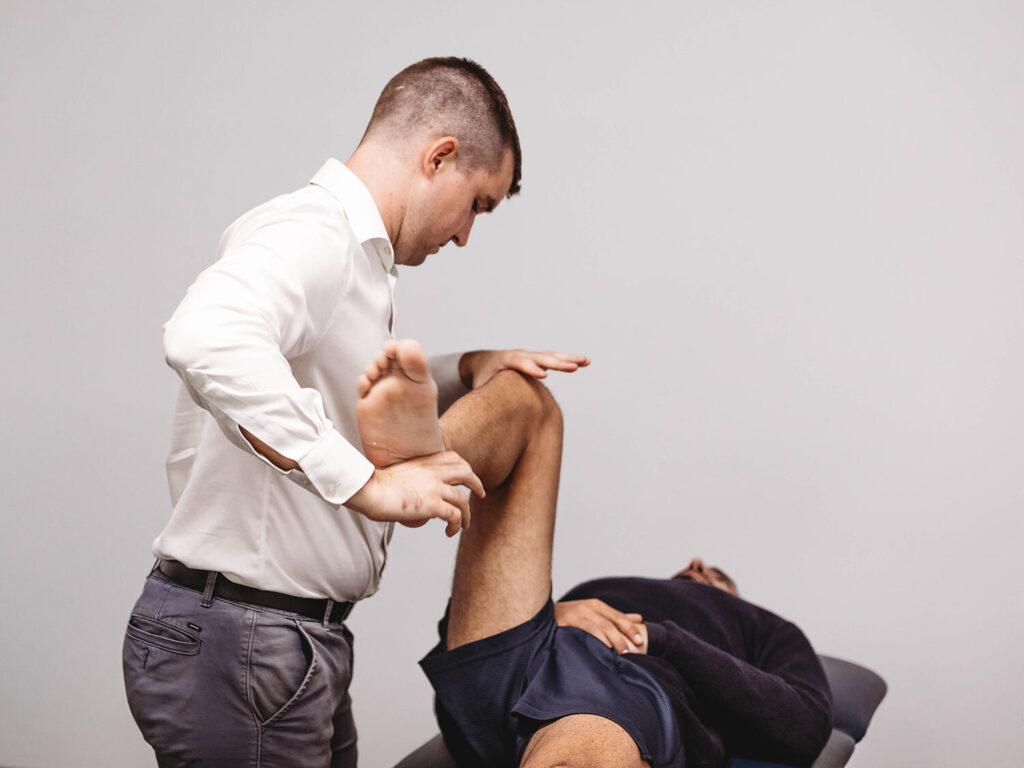
Understanding Hamstring injury
A hamstring injury is damage to one or more of the three muscles running down the back of your thigh, or to the tendons that anchor them at the hip and knee. Most happen suddenly during sprinting, kicking or a long stride, though some build slowly as tendon pain near the sit bone.
Your physiotherapist works out which tissue is involved, how much load it can handle right now, and what has to change so it holds up when you go back to sport or work. Rehabilitation is built around progressive strength, not rest alone.
Who does it affect?
runners, footballers, cricketers and dancers, plus anyone who sprints, kicks or lunges without regular hamstring strength work. It can also happen if a person slips, landing in a split position. It doesn’t just happen in athletes.
How common is it?
hamstring strains are among the most frequently reported muscle injuries in running and kicking sports.
What is the recovery like?
varies widely with the grade of injury, where it sits and the demands you return to.
Who should I see for treatment?
your physiotherapist, with referral for imaging or a specialist opinion when the presentation warrants it.
What funding options are available?
Medicare, NDIS, DVA and private health funds accepted.
What is a hamstring injury?
Your hamstrings are three muscles at the back of the thigh. They slow your leg down as it swings forward, then drive you into the next stride. That braking role is where most injuries happen.
A strain occurs when the muscle is lengthening under high force, usually at top speed or during an over-stride. Fibres tear at the junction between muscle and tendon, which is why the pain often sits in a narrow band rather than across the whole thigh. Tendon injuries develop differently, building over weeks as pain deep near the sit bone.
Contributing factors include:
Low hamstring strength at long muscle lengths, and short / weak fascicle lengths particularly on one side
A sharp jump in sprinting volume, match minutes or hill work
A previous hamstring injury that was not rehabilitated to full strength
Fatigue late in a session, when stride control drops off
Restricted hip or trunk movement that forces the hamstring to work harder
Reduced control of the pelvis during single-leg loading
Age of the person
Failure to expose the rehabbing hamstring to game play and sprint exposure
Symptoms of Hamstring injury
Sudden sharp pain at the back of the thigh during sprinting, kicking or a lunge
Pain when you lengthen the leg, such as reaching for a step or bending to pick something up
Tenderness over a specific spot when you press along the muscle
Bruising down the back of the thigh, sometimes appearing a day or two later
Weakness or a loss of push-off speed, even once the sharp pain settles
A pulling or cramping feeling that returns each time you build speed back up
Your treatment plan comes out of the assessment, because the tissue involved and the demands you return to change what needs loading.
What to expect at your first appointment
Tell us what is going on
How the injury happened, what you felt at the time, what you have tried, and what you need the leg to do again.
A full assessment
Your physiotherapist examines strength, flexibility, pain location, hip and back movement, and how you control the leg on one side.
A clear plan
You leave knowing what the injury is, which exercises start today, and what has to be met before you progress.
Review and adjust
Follow-up appointments track strength and running load, and the program steps up as the tissue responds.
When to book an appointment
Pain in the back of your thigh has lasted more than a week
You cannot walk pain free after the injury
You cannot run, kick, sprint or sit comfortably for as long as you need to
You are unsure whether the problem is your hamstring, your tendon or your lower back
Book an assessment if:
Looking after yourself at home
These general steps suit most hamstring injuries in the early stages.
Low hamstring strength at long muscle lengths, and short / weak fascicle lengths particularly on one side
A sharp jump in sprinting volume, match minutes or hill work
A previous hamstring injury that was not rehabilitated to full strength
Fatigue late in a session, when stride control drops off
Restricted hip or trunk movement that forces the hamstring to work harder
Reduced control of the pelvis during single-leg loading
Age of the person
Failure to expose the rehabbing hamstring to game play and sprint exposure

Meet the team who treat this
Behind every appointment is a team of practitioners who know each other, trust each other and work together for you. Across seven clinics and nine disciplines, our team shares expertise, coordinates treatment plans and celebrates your progress together.

Aimee Fuller
Healthcare Support Officer
Available at Blaxland

Alicia Whiticker
Healthcare Support Officer
Available at Blaxland

Amanda Banks
Healthcare Support Officer
Available at Blaxland

Amanda Duggan
Healthcare Support Officer
Available at Blaxland

Amy Meekings
Healthcare Support Officer
Available at Blaxland

Anita Beerapu
Healthcare Support Officer
Available at Blaxland

Benjamin Tucker
Healthcare Support Officer
Available at Blaxland

Blake Cossar
Healthcare Support Officer
Available at Blaxland

Bronte Tupper
Healthcare Support Officer
Available at Blaxland

Chris Farrugia
Healthcare Support Officer
Available at Blaxland

Corrina Aitken
Healthcare Support Officer
Available at Blaxland

David Logue
Healthcare Support Officer
Available at Blaxland

Dean Gresser
Healthcare Support Officer
Available at Blaxland

Emma Nassif
Healthcare Support Officer
Available at Blaxland

Esha Sharma
Healthcare Support Officer
Available at Blaxland

Fatima Hussaini
Healthcare Support Officer
Available at Blaxland

Felicity Spencer-Davey
Healthcare Support Officer
Available at Blaxland

Frankie Raikadroka
Healthcare Support Officer
Available at Blaxland

Hannah Norrie
Healthcare Support Officer
Available at Blaxland

Heather Edwards
Healthcare Support Officer
Available at Blaxland

Isaac Vella
Healthcare Support Officer
Available at Blaxland

Jarrah Nesbitt
Healthcare Support Officer
Available at Blaxland

Jonathan Lopez
Healthcare Support Officer
Available at Blaxland

Justin Hanna
Healthcare Support Officer
Available at Blaxland

Kasey Collins
Healthcare Support Officer
Available at Blaxland

Katrina Gauci
Healthcare Support Officer
Available at Blaxland

Kennedy Touet
Healthcare Support Officer
Available at Blaxland

Kristy Edwards
Healthcare Support Officer
Available at Blaxland

Kyle Perry
Healthcare Support Officer
Available at Blaxland

Lorna Nicastri
Healthcare Support Officer
Available at Blaxland

Maja Bosic
Healthcare Support Officer
Available at Blaxland

Marxy Koronel
Healthcare Support Officer
Available at Blaxland

Matt Barton
Healthcare Support Officer
Available at Blaxland

Michael Todd
Healthcare Support Officer
Available at Blaxland

Mr Jeffery Jenkins FACPS
Healthcare Support Officer
Available at Blaxland

Nathan Cavanagh
Healthcare Support Officer
Available at Blaxland

Patrick Celeban
Healthcare Support Officer
Available at Blaxland

Praise Khin
Healthcare Support Officer
Available at Blaxland

Sarah Bonnici
Healthcare Support Officer
Available at Blaxland

Shannon Smith
Healthcare Support Officer
Available at Blaxland

Siobhan Kelly
Healthcare Support Officer
Available at Blaxland

Taleisha Bozzi
Healthcare Support Officer
Available at Blaxland

Trystan Singh
Healthcare Support Officer
Available at Blaxland

Uty Kotwal
Healthcare Support Officer
Available at Blaxland

Yoni Hochberg
Healthcare Support Officer
Available at Blaxland

Zak Lloyd
Healthcare Support Officer
Available at Blaxland
EPC, DVA, NDIS and WorkCover welcome
Nearly half of our appointments are funded through Medicare, DVA, NDIS or WorkCover. We manage the paperwork so you can focus on your health.


NDIS
We support eligible NDIS participants across podiatry, physiotherapy, exercise physiology, dietetics and psychology, depending on your plan and goals. Eligibility and funding are set by your plan.

Medicare
Medicare may rebate podiatry, physiotherapy, exercise physiology and dietetics sessions when your GP refers you under an Enhanced Primary Care (EPC) or Chronic Disease Management (CDM) plan, and psychology sessions under a Mental Health Care Plan. The number of sessions is set by your plan.

DVA
Gold and White card holders can access DVA-funded care across our services with a valid referral.

WorkCover
If you have been injured at work, we accept WorkCover referrals for physiotherapy, exercise physiology and psychology, and manage the paperwork with your insurer, with a clear return-to-work plan.
Seven clinics across three regions
Find a clinic near you. Each location is staffed by local practitioners who know your community.
Penrith
Western SydneyOur largest centre, with our full range of services under one roof.
Ropes Crossing
Western SydneyPodiatry, at Ropes Crossing Village.
Blaxland
Blue MountainsPodiatry, physiotherapy, exercise physiology and group classes.
Springwood
Blue MountainsPodiatry, dietetics and a boutique footwear store.
Katoomba
Blue MountainsPodiatry, physiotherapy and dietetics, in a restored 1914 cottage.
Ryde
North ShorePodiatry, physiotherapy, dietetics and exercise physiology, with a footwear store and gait analysis.
Lindfield
North ShorePodiatry, with mobile podiatry across the North Shore and Northern Beaches.
Ready to get back up to speed?
Book a physiotherapy assessment and get a clear plan for your hamstring.
















Frequently asked questions
What is the difference between a hamstring strain and hamstring tendinopathy?
A strain is a tear in muscle fibres, usually sudden and felt mid-thigh during sprinting. Tendinopathy is a gradual change in the tendon, most often where the hamstring attaches to the sit bone, and it builds over weeks. They need different loading. Strains progress through lengthened strength work and sprint retraining, while tendinopathy usually starts with isometric holds and avoids deep hip-bend positions early on.
Why does my hamstring hurt most when I sit down or drive?
Deep pain under the sit bone when sitting is typical of proximal hamstring tendinopathy. Sitting compresses the tendon against the bone, so pain rises the longer you stay there and eases once you stand. Long drives, hard chairs and cycling often flare it. Softer seating, regular position changes and a graded strength program are usually part of the approach.
Do Nordic hamstring exercises help?
Nordic curls are one of the better-studied exercises for hamstring strength, and research in football populations links regular use to lower injury rates. They load the muscle while it lengthens, which is the position most strains occur in. They are demanding, so they are introduced gradually, often starting with assisted or partial-range versions rather than the full movement.
Is heavy bruising down the back of my thigh a concern?
Bruising means small blood vessels have torn, and gravity often carries it down toward the knee or calf over a few days. On its own it does not tell you the grade of injury. What matters more is whether you can bear weight, whether there is a visible gap in the muscle, and how much strength you have lost. Have significant bruising assessed.
Why do hamstring injuries often happen late in a game or training session?
Fatigue reduces the muscle’s ability to absorb force and changes your running mechanics, so stride length and control drop off. Studies of match data show a cluster of hamstring injuries in the closing stages of each half. Building sprint conditioning, so late-game running feels closer to early-game running, is a practical part of reducing that risk.
Can stretching before sport prevent a hamstring injury?
Stretching alone has not been shown to prevent hamstring injuries. Long static stretches before sprinting can briefly reduce force output. A better warm-up combines gradual pace increases, dynamic leg swings and a few build-up runs at close to full speed. Strength work carried out across the week does far more for prevention than anything done in the ten minutes beforehand.