

Tension headache
Find out what is driving your headaches, and what will settle them
That tight band of pressure across your forehead, pain behind your eyes or the ache that creeps up from your neck by mid-afternoon, is not something you have to push through. Headaches are common, they usually have a cause you can act on, and they respond well to treatment.
Medicare, NDIS, DVA and private health funds accepted.
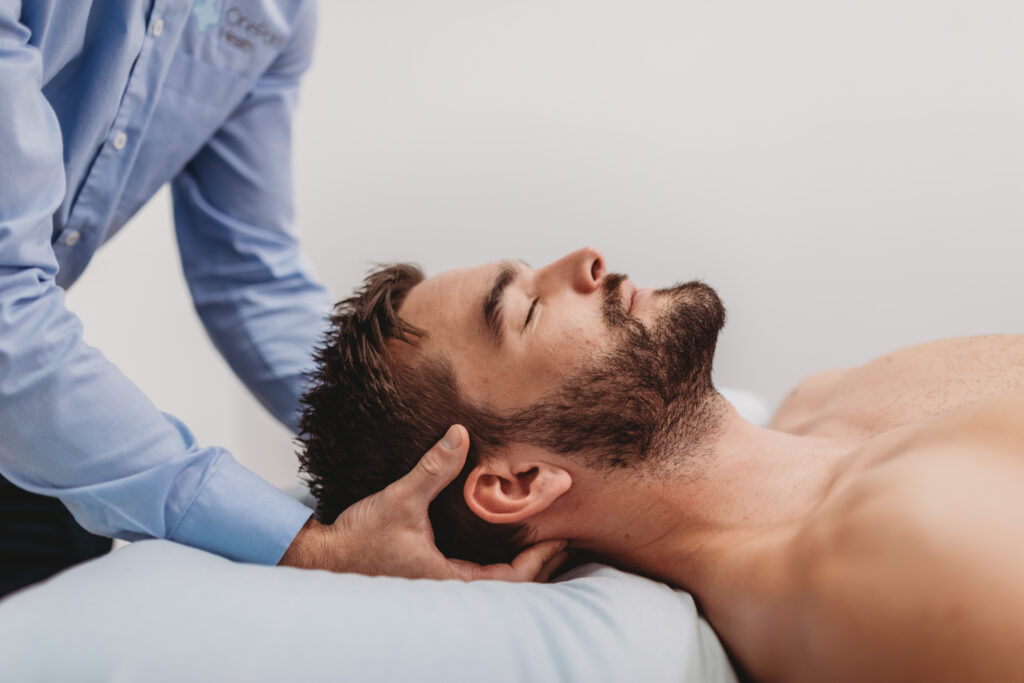
Understanding Tension headache
A tension headache is felt as steady pressure or tightness on both sides of the head, often with tight, painful muscles through the neck, jaw and shoulders. It builds rather than throbs, and it is usually linked to how your neck and upper back are loaded, along with stress, sleep and screen time.
Not every headache is a tension headache. Your assessment sorts out whether the pain is coming from the neck joints and muscles, whether it fits a migraine pattern, or whether something else needs attention first. That answer shapes what you do next.
Who does it affect?
adults of any age, and it is common in people who work at a desk, drive long hours, study, or carry stress in the neck and shoulders.
How common is it?
tension-type headache is the most common type of headache.
What is the recovery like?
varies. Many people notice a change within a few weeks, while long-standing patterns take longer to shift.
Who should I see for treatment?
physiotherapists at OnePointHealth.
What funding options are available?
Medicare, NDIS, DVA and private health funds accepted.
What causes headaches?
A headache is pain felt in the head, face or upper neck. Most headaches are not caused by anything sinister. They come from the muscles, joints and nerves of the head and neck, or from a change in how the brain processes pain signals, as happens in migraine.
Tension-type headache usually builds slowly. Muscles through the back of the neck, the base of the skull and the top of the shoulders stay loaded for hours at a time, often in one sustained position. The tissue becomes sensitive, and pain refers up over the scalp, across the forehead and behind the eyes. Cervicogenic headache works differently: it starts in the upper neck joints and refers pain into the head, so it often affects one side and moves with your neck.
Common contributing factors include:
Sustained postures at a desk, in a car, or over a phone, especially with limited breaks
Stress, poor sleep and low activity levels, which raise muscle tension and lower pain tolerance
Neck and upper back stiffness, weak deep neck muscles, or an old neck injury
Jaw clenching and teeth grinding, which load the muscles around the temples
Dehydration, skipped meals, alcohol and caffeine changes
Eye strain from screens or an out-of-date prescription
Symptoms of Tension headache
Headaches present in different ways, and how yours behaves matters more than how much it hurts. Common features include:
Pressure, tightness or a band-like ache across the forehead, temples or back of the head
Pain that builds through the day rather than pulsing or throbbing
Tightness and tenderness through the neck, jaw and shoulders
Stiffness or pain when you turn or hold your head in one position
Pain behind or above one eye
Pain across the forehead
Tiredness, poor concentration and disrupted sleep during a run of headaches
Your assessment tells us which structures are driving the pain and which triggers are keeping it going. Your plan is built from that, not from a standard headache protocol.
What to expect at your first appointment
Tell us what is going on
You describe where the pain sits, how it starts, how long it lasts, what makes it better or worse, and what you have already tried.
A full assessment
Your physiotherapist or chiropractor checks neck movement, joint mobility, muscle tenderness, jaw function and strength, and screens for anything that needs medical review.
A clear plan
You leave knowing what type of headache you are dealing with, what is driving it, what treatment involves and what you can do between visits.
Review and adjust
You track your headaches, and your plan changes as the frequency and intensity change.
When to book an appointment
Your headaches have been happening for more than a few weeks
They are affecting your work, sleep, driving or training
Stretching, heat, hydration or over-the-counter medication is not holding them off
You are unsure whether the pain is coming from your neck, your jaw or something else
Book an assessment if:
Looking after yourself at home
These steps support your treatment between appointments.
Sustained postures at a desk, in a car, or over a phone, especially with limited breaks
Stress, poor sleep and low activity levels, which raise muscle tension and lower pain tolerance
Neck and upper back stiffness, weak deep neck muscles, or an old neck injury
Jaw clenching and teeth grinding, which load the muscles around the temples
Dehydration, skipped meals, alcohol and caffeine changes
Eye strain from screens or an out-of-date prescription

Meet the team who treat this
Behind every appointment is a team of practitioners who know each other, trust each other and work together for you. Across seven clinics and nine disciplines, our team shares expertise, coordinates treatment plans and celebrates your progress together.

Aimee Fuller
Healthcare Support Officer
Available at Blaxland

Alicia Whiticker
Healthcare Support Officer
Available at Blaxland

Amanda Banks
Healthcare Support Officer
Available at Blaxland

Amanda Duggan
Healthcare Support Officer
Available at Blaxland

Amy Meekings
Healthcare Support Officer
Available at Blaxland

Anita Beerapu
Healthcare Support Officer
Available at Blaxland

Benjamin Tucker
Healthcare Support Officer
Available at Blaxland

Blake Cossar
Healthcare Support Officer
Available at Blaxland

Bronte Tupper
Healthcare Support Officer
Available at Blaxland

Chris Farrugia
Healthcare Support Officer
Available at Blaxland

Corrina Aitken
Healthcare Support Officer
Available at Blaxland

David Logue
Healthcare Support Officer
Available at Blaxland

Dean Gresser
Healthcare Support Officer
Available at Blaxland

Emma Nassif
Healthcare Support Officer
Available at Blaxland

Esha Sharma
Healthcare Support Officer
Available at Blaxland

Fatima Hussaini
Healthcare Support Officer
Available at Blaxland

Felicity Spencer-Davey
Healthcare Support Officer
Available at Blaxland

Frankie Raikadroka
Healthcare Support Officer
Available at Blaxland

Hannah Norrie
Healthcare Support Officer
Available at Blaxland

Heather Edwards
Healthcare Support Officer
Available at Blaxland

Isaac Vella
Healthcare Support Officer
Available at Blaxland

Jarrah Nesbitt
Healthcare Support Officer
Available at Blaxland

Jonathan Lopez
Healthcare Support Officer
Available at Blaxland

Justin Hanna
Healthcare Support Officer
Available at Blaxland

Kasey Collins
Healthcare Support Officer
Available at Blaxland

Katrina Gauci
Healthcare Support Officer
Available at Blaxland

Kennedy Touet
Healthcare Support Officer
Available at Blaxland

Kristy Edwards
Healthcare Support Officer
Available at Blaxland

Kyle Perry
Healthcare Support Officer
Available at Blaxland

Lorna Nicastri
Healthcare Support Officer
Available at Blaxland

Maja Bosic
Healthcare Support Officer
Available at Blaxland

Marxy Koronel
Healthcare Support Officer
Available at Blaxland

Matt Barton
Healthcare Support Officer
Available at Blaxland

Michael Todd
Healthcare Support Officer
Available at Blaxland

Mr Jeffery Jenkins FACPS
Healthcare Support Officer
Available at Blaxland

Nathan Cavanagh
Healthcare Support Officer
Available at Blaxland

Patrick Celeban
Healthcare Support Officer
Available at Blaxland

Praise Khin
Healthcare Support Officer
Available at Blaxland

Sarah Bonnici
Healthcare Support Officer
Available at Blaxland

Shannon Smith
Healthcare Support Officer
Available at Blaxland

Siobhan Kelly
Healthcare Support Officer
Available at Blaxland

Taleisha Bozzi
Healthcare Support Officer
Available at Blaxland

Trystan Singh
Healthcare Support Officer
Available at Blaxland

Uty Kotwal
Healthcare Support Officer
Available at Blaxland

Yoni Hochberg
Healthcare Support Officer
Available at Blaxland

Zak Lloyd
Healthcare Support Officer
Available at Blaxland
EPC, DVA, NDIS and WorkCover welcome
Nearly half of our appointments are funded through Medicare, DVA, NDIS or WorkCover. We manage the paperwork so you can focus on your health.

NDIS
We support eligible NDIS participants across podiatry, physiotherapy, exercise physiology, dietetics and psychology, depending on your plan and goals. Eligibility and funding are set by your plan.

Medicare
Medicare may rebate podiatry, physiotherapy, exercise physiology and dietetics sessions when your GP refers you under an Enhanced Primary Care (EPC) or Chronic Disease Management (CDM) plan, and psychology sessions under a Mental Health Care Plan. The number of sessions is set by your plan.

DVA
Gold and White card holders can access DVA-funded care across our services with a valid referral.

WorkCover
If you have been injured at work, we accept WorkCover referrals for physiotherapy, exercise physiology and psychology, and manage the paperwork with your insurer, with a clear return-to-work plan.
Seven clinics across three regions
Find a clinic near you. Each location is staffed by local practitioners who know your community.
Penrith
Western SydneyOur largest centre, with our full range of services under one roof.
Ropes Crossing
Western SydneyPodiatry, at Ropes Crossing Village.
Blaxland
Blue MountainsPodiatry, physiotherapy, exercise physiology and group classes.
Springwood
Blue MountainsPodiatry, dietetics and a boutique footwear store.
Katoomba
Blue MountainsPodiatry, physiotherapy and dietetics, in a restored 1914 cottage.
Ryde
North ShorePodiatry, physiotherapy, dietetics and exercise physiology, with a footwear store and gait analysis.
Lindfield
North ShorePodiatry, with mobile podiatry across the North Shore and Northern Beaches.
Ready to get on top of your headaches?
Book an assessment, find out what is driving the pain, and leave with a plan.
















Frequently asked questions
What is the difference between a tension headache and a migraine?
A tension headache is steady pressure on both sides of the head, and you can usually keep functioning through it. A migraine is more often throbbing, on one side, and comes with nausea, or sensitivity to light and sound. Migraine attacks commonly force you to stop and lie down, and some people get visual disturbance beforehand. The two can occur in the same person, which is why the pattern of each episode matters.
Can dehydration, caffeine or skipped meals trigger a headache?
Yes. Low fluid intake, a long gap between meals, alcohol and changes in caffeine intake are all recognised headache triggers. Caffeine is the one people miss most often: a sudden drop, such as on a weekend or a day off, can bring on a withdrawal headache by mid-morning. Keeping intake steady, rather than cutting it out abruptly, tends to work better.
Can pain medication make headaches more frequent?
It can. Taking pain relief for headaches on most days of the week over several weeks can lead to medication overuse headache, where the medication itself starts driving the pattern. The headaches become more frequent and respond less well. If you are reaching for tablets more than a couple of days a week, raise it with your GP or pharmacist before changing anything, because some medications need a staged reduction.
Do children and teenagers get tension headaches?
Yes, and they become more common through the high school years. Screen time, heavy school bags, exam stress, irregular sleep and skipped meals all contribute. A new or changing headache in a child should be reviewed by a GP first. Once medical causes have been excluded, treatment follows the same principles as for adults, with more emphasis on sleep routine, hydration and study set-up.
Can eye strain or new glasses cause headaches?
Eye strain can contribute to headaches, particularly a dull ache behind or above the eyes after long screen work. An out-of-date prescription, an uncorrected astigmatism or new progressive lenses can also cause you to hold your head at an angle, which loads the neck. If your headaches started around a vision change or you are squinting to read screens, an optometrist review is worth booking alongside treatment.
What should I record in a headache diary?
Record the date and time each headache starts, how long it lasts, where the pain sits, its intensity out of ten, and any medication taken. Add sleep hours, meals, caffeine, alcohol, stress and workload. Two to four weeks of entries usually reveals a pattern that is hard to see day to day, and it gives a clear baseline to measure your progress against.