

Knee pain
Find out what is actually causing your knee pain
Your knee aches on the stairs, grumbles after a run, or swells up the day after sport. Knee pain has many causes, and most of them respond well to the right physiotherapy plan.
Medicare, NDIS, DVA and private health funds accepted.
Understanding Knee pain
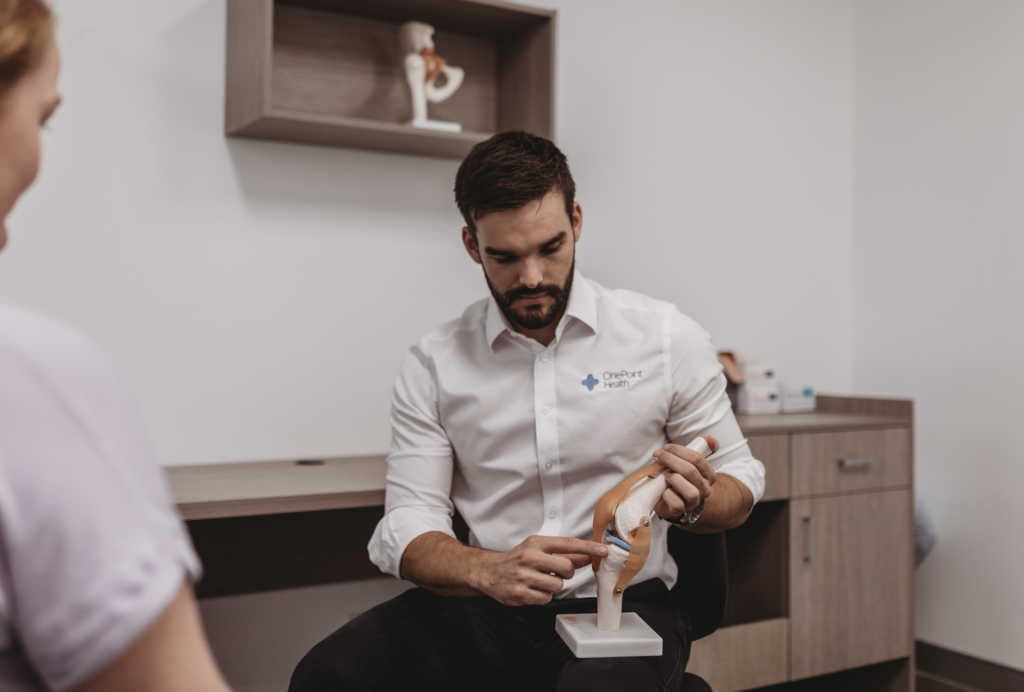
Knee pain is a symptom, not a diagnosis. It can start with a single twist, tackle or fall, or it can creep in over weeks of running, kneeling, squatting or standing at work. The same ache can come from the kneecap, the cartilage, a tendon, a ligament or the joint surface itself.
Working out which structure is producing your pain, and what is overloading it, is the whole job. Your physiotherapist assesses how your knee, hip and ankle move together, tests the structures that reproduce your symptoms, then builds a plan to settle the pain and rebuild strength.
Who does it affect?
runners, court and field sport players, tradespeople who kneel or squat, and adults over 45 whose knees are carrying more load than they are used to/prepared for..
How common is it?
knee pain is one of the most common reasons Australians see a physiotherapist [CONFIRM: prevalence figure and source for knee pain in Australian adults].
What is the recovery like?
varies with the cause, how long you have had it and how much load your knee needs to handle.
Who should I see for treatment?
your physiotherapist, with referral to a GP or specialist if imaging or an opinion is needed.
What funding options are available?
Medicare, NDIS, DVA and private health funds accepted.
What causes knee pain?
Your knee is a hinge that carries your body weight while your hip and ankle steer it. Four bones, two cartilage discs, four main ligaments and several large tendons all work together every time you take a step. Pain starts when one of those structures takes more load than it can currently handle.
Sudden knee pain usually follows a clear moment: a twist with your foot planted, a heavy landing, a knock to the side of the joint. Gradual knee pain builds when training load, work demands or body weight rise faster than your muscles and tendons adapt. Both are common, and they need different plans.
Common contributing factors include:
A jump in training: more running kilometres, more hills, more court time or a return to sport after a long break.
Strength and control gaps: weak quadriceps, glutes or calves let your kneecap and joint surfaces take load they are not built for.
Load at work: repeated kneeling, squatting, ladder work or long days on concrete.
Previous injury: an old ligament tear, meniscus injury or knee surgery changes how your knee shares load.
Joint changes with age: cartilage and joint surfaces change over time, and stiffness or pain can follow.
Referred pain: hip and lower back problems can send pain into the front or side of the knee.
Symptoms of Knee pain
Knee pain shows up differently depending on what is driving it. Yours might include:
Pain at the front of the knee on stairs, hills, squatting or after long periods sitting.
Swelling, either straight after an injury or the day after activity.
Clicking, grinding, catching or a feeling that the knee locks briefly.
Giving way, buckling or a sense that you cannot trust the knee under load.
Stiffness first thing in the morning, or after sitting still.
Pain that starts mid-run or mid-game and eases with rest, then returns at the same point.
Your plan comes from your assessment, so it targets the structure producing your pain and the load driving it.
What to expect at your first appointment
Tell us what is going on
You describe when the pain started, where you feel it, what makes it worse and what you need to get back to.
A full assessment
Your physiotherapist checks your knee range, strength, swelling and stability, tests the structures that reproduce your pain, and watches how you squat, step and walk.
A clear plan
You leave knowing the likely cause, what to do this week, what to avoid for now, and roughly how your rehab will progress.
Review and adjust
At each visit we retest, load your knee harder as it improves, and refer for imaging or a specialist opinion if anything suggests you need one.
When to book an appointment
Your knee pain is limiting your usual activities, affecting your confidence with movement, or keeps coming back when you increase your activity.
You are limping, avoiding stairs, changing how you train, or missing work or sport.
Rest, ice and over-the-counter pain relief have not settled it.
You are not sure what you have done, or whether it is safe to keep running or training.
Book an assessment if:
Looking after yourself at home
These steps help most knee pain while you wait for your appointment.
A jump in training: more running kilometres, more hills, more court time or a return to sport after a long break.
Strength and control gaps: weak quadriceps, glutes or calves let your kneecap and joint surfaces take load they are not built for.
Load at work: repeated kneeling, squatting, ladder work or long days on concrete.
Previous injury: an old ligament tear, meniscus injury or knee surgery changes how your knee shares load.
Joint changes with age: cartilage and joint surfaces change over time, and stiffness or pain can follow.
Referred pain: hip and lower back problems can send pain into the front or side of the knee.

Meet the team who treat this
Behind every appointment is a team of practitioners who know each other, trust each other and work together for you. Across seven clinics and nine disciplines, our team shares expertise, coordinates treatment plans and celebrates your progress together.

Aimee Fuller
Healthcare Support Officer
Available at Blaxland

Alicia Whiticker
Healthcare Support Officer
Available at Blaxland

Amanda Banks
Healthcare Support Officer
Available at Blaxland

Amanda Duggan
Healthcare Support Officer
Available at Blaxland

Amy Meekings
Healthcare Support Officer
Available at Blaxland

Anita Beerapu
Healthcare Support Officer
Available at Blaxland

Benjamin Tucker
Healthcare Support Officer
Available at Blaxland

Blake Cossar
Healthcare Support Officer
Available at Blaxland

Bronte Tupper
Healthcare Support Officer
Available at Blaxland

Chris Farrugia
Healthcare Support Officer
Available at Blaxland

Corrina Aitken
Healthcare Support Officer
Available at Blaxland

David Logue
Healthcare Support Officer
Available at Blaxland

Dean Gresser
Healthcare Support Officer
Available at Blaxland

Emma Nassif
Healthcare Support Officer
Available at Blaxland

Esha Sharma
Healthcare Support Officer
Available at Blaxland

Fatima Hussaini
Healthcare Support Officer
Available at Blaxland

Felicity Spencer-Davey
Healthcare Support Officer
Available at Blaxland

Frankie Raikadroka
Healthcare Support Officer
Available at Blaxland

Hannah Norrie
Healthcare Support Officer
Available at Blaxland

Heather Edwards
Healthcare Support Officer
Available at Blaxland

Isaac Vella
Healthcare Support Officer
Available at Blaxland

Jarrah Nesbitt
Healthcare Support Officer
Available at Blaxland

Jonathan Lopez
Healthcare Support Officer
Available at Blaxland

Justin Hanna
Healthcare Support Officer
Available at Blaxland

Kasey Collins
Healthcare Support Officer
Available at Blaxland

Katrina Gauci
Healthcare Support Officer
Available at Blaxland

Kennedy Touet
Healthcare Support Officer
Available at Blaxland

Kristy Edwards
Healthcare Support Officer
Available at Blaxland

Kyle Perry
Healthcare Support Officer
Available at Blaxland

Lorna Nicastri
Healthcare Support Officer
Available at Blaxland

Maja Bosic
Healthcare Support Officer
Available at Blaxland

Marxy Koronel
Healthcare Support Officer
Available at Blaxland

Matt Barton
Healthcare Support Officer
Available at Blaxland

Michael Todd
Healthcare Support Officer
Available at Blaxland

Mr Jeffery Jenkins FACPS
Healthcare Support Officer
Available at Blaxland

Nathan Cavanagh
Healthcare Support Officer
Available at Blaxland

Patrick Celeban
Healthcare Support Officer
Available at Blaxland

Praise Khin
Healthcare Support Officer
Available at Blaxland

Sarah Bonnici
Healthcare Support Officer
Available at Blaxland

Shannon Smith
Healthcare Support Officer
Available at Blaxland

Siobhan Kelly
Healthcare Support Officer
Available at Blaxland

Taleisha Bozzi
Healthcare Support Officer
Available at Blaxland

Trystan Singh
Healthcare Support Officer
Available at Blaxland

Uty Kotwal
Healthcare Support Officer
Available at Blaxland

Yoni Hochberg
Healthcare Support Officer
Available at Blaxland

Zak Lloyd
Healthcare Support Officer
Available at Blaxland
EPC, DVA, NDIS and WorkCover welcome
Nearly half of our appointments are funded through Medicare, DVA, NDIS or WorkCover. We manage the paperwork so you can focus on your health.


NDIS
We support eligible NDIS participants across podiatry, physiotherapy, exercise physiology, dietetics and psychology, depending on your plan and goals. Eligibility and funding are set by your plan.

Medicare
Medicare may rebate podiatry, physiotherapy, exercise physiology and dietetics sessions when your GP refers you under an Enhanced Primary Care (EPC) or Chronic Disease Management (CDM) plan, and psychology sessions under a Mental Health Care Plan. The number of sessions is set by your plan.

DVA
Gold and White card holders can access DVA-funded care across our services with a valid referral.

WorkCover
If you have been injured at work, we accept WorkCover referrals for physiotherapy, exercise physiology and psychology, and manage the paperwork with your insurer, with a clear return-to-work plan.
Seven clinics across three regions
Find a clinic near you. Each location is staffed by local practitioners who know your community.
Penrith
Western SydneyOur largest centre, with our full range of services under one roof.
Ropes Crossing
Western SydneyPodiatry, at Ropes Crossing Village.
Blaxland
Blue MountainsPodiatry, physiotherapy, exercise physiology and group classes.
Springwood
Blue MountainsPodiatry, dietetics and a boutique footwear store.
Katoomba
Blue MountainsPodiatry, physiotherapy and dietetics, in a restored 1914 cottage.
Ryde
North ShorePodiatry, physiotherapy, dietetics and exercise physiology, with a footwear store and gait analysis.
Lindfield
North ShorePodiatry, with mobile podiatry across the North Shore and Northern Beaches.
Ready to sort out that knee pain?
Book an assessment and find out what is causing it, and what will fix it.
















Frequently asked questions
Why does my knee hurt more going down stairs than going up?
Going downstairs loads your kneecap and quadriceps far harder than going up, because your muscles work while lengthening to control your body weight. Your knee also bends under close to full load with every step down. Pain that is worse descending stairs, hills or slopes usually points to the front of the knee. It is a useful clue, and one your physiotherapist will test directly.
Can knee pain come from my hip or lower back?
Yes. Pain felt in the knee can be referred from the hip joint or from nerves in the lower back, and the knee itself may test completely normal. Hip osteoarthritis commonly refers pain into the front of the thigh and knee. This is why your assessment includes your hip and back, not just the painful joint, especially when nothing you do to the knee changes the pain.
What does it mean if my knee clicks, grinds or catches?
Painless clicking and grinding is very common and usually harmless, caused by tendons moving over bone or fluid shifting inside the joint. Noise on its own is not a sign of damage. Catching or locking is different: if your knee jams and will not straighten, something may be physically blocking the joint, and that needs assessing promptly rather than waiting to see if it settles.
Does squatting deep or kneeling damage your knees?
No. Squatting and kneeling load your knees, and load is what keeps cartilage, tendons and muscle healthy. Problems arise when the amount of load rises faster than your knee has adapted to, not from the movement itself. If squatting or kneeling hurts right now, the answer is usually to reduce depth or volume temporarily and build strength, rather than avoid the movement permanently.
My knee swelled up straight after an injury. What does that mean?
Swelling within the first hour or two generally means bleeding inside the joint, which suggests a more significant structure has been injured, such as a ligament, cartilage or bone surface. Swelling that appears the next morning is more often an inflammatory response to overload. Tell your physiotherapist how fast the swelling came on and how large it was, because that timing genuinely changes what we look for.
Can my running shoes or running technique cause knee pain?
They contribute, but they are rarely the whole story. Very short stride length, low cadence, heavy landing or a sudden change of shoe can all shift load onto your knee. Training volume and strength usually matter more. A running assessment films your gait and measures your strength, so any change we suggest to your technique or footwear is based on what your body is actually doing.