

Morton's neuroma
Burning pain in the ball of your foot? Let's take the pressure off that nerve.
It feels like a stone under the ball of your foot, or a burning pain that shoots into your toes when you walk. Morton’s neuroma is treatable, and it can often be managed without surgery.
Medicare, NDIS, DVA and private health funds accepted.
Understanding Morton’s neuroma
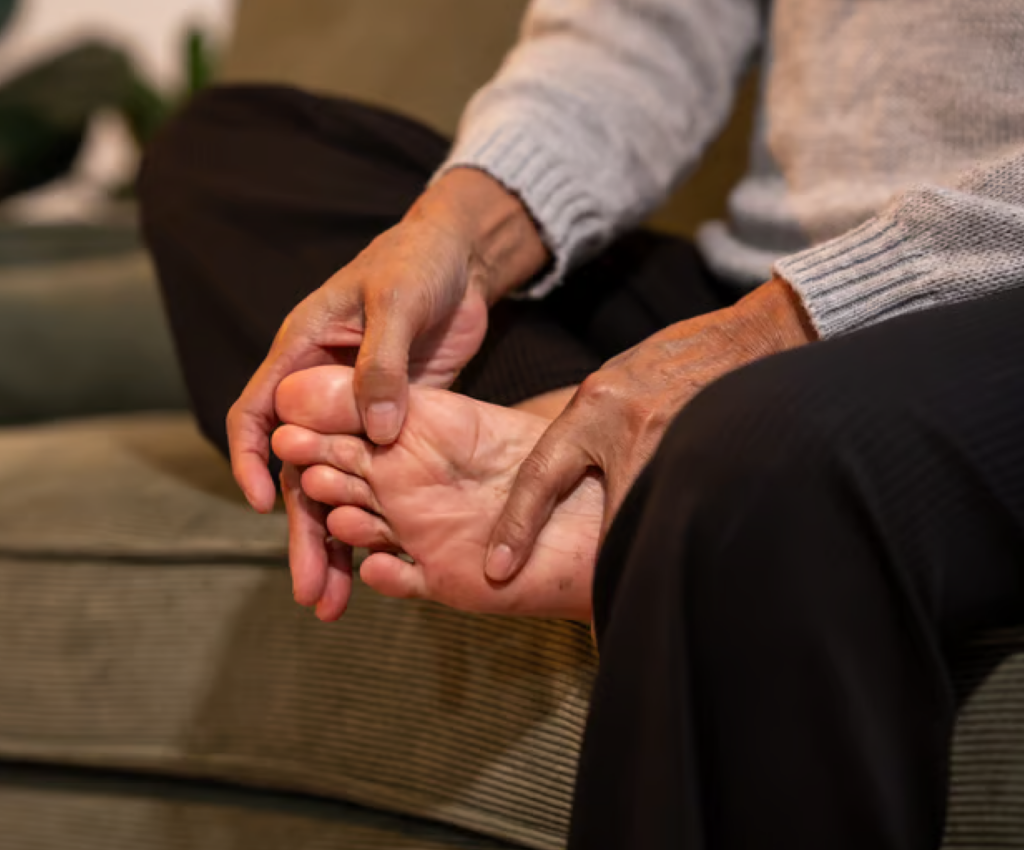
Morton’s neuroma is a thickening of the tissue around one of the nerves that runs between the long bones of your foot. It usually sits between the third and fourth toes. Increased pressure can irritate that nerve, you get burning pain, numbness or the sensation of a pebble under the ball of your foot.
Treatment works by taking load and compression off the nerve. Your podiatrist looks at your footwear, the way your forefoot spreads under load, and how much time you spend on your feet, reduces pressure on the nerve. Injections and surgery are options later, not first.
Who does it affect?
adults, most often between 40 and 60, and more often women than men.
How common is it?
it is one of the more frequent causes of pain in the ball of the foot.
What is the recovery like?
varies, and depends on how long the nerve has been compressed and how much you can change your footwear and load.
Who should I see for treatment?
your podiatrist, with referral for imaging or a surgical opinion if needed.
What funding options are available?
Medicare, NDIS, DVA and private health funds accepted.
What is Morton's neuroma?
Morton’s neuroma is not a tumour, despite the name. It is a build-up of fibrous tissue around a nerve where it passes between two metatarsals, the long bones behind your toes. That extra bulk makes the nerve thicker, so it gets pinched every time the bones move together.
It usually develops slowly. Repeated compression inflames the nerve, the tissue around it thickens in response, and the thicker nerve is then easier to compress. Once that cycle starts, standing and walking keep feeding it.
Common contributing factors include:
Narrow shoes, pointed toe boxes and heels above about 4cm, which push the metatarsals together
Long hours standing or walking on hard surfaces
A sudden jump in running, walking or court sport volume
Foot shape, including flat feet, high arches and a longer second toe
Bunions or clawed toes, which change how pressure spreads across the forefoot
Previous injury or surgery to the forefoot
Symptoms of Morton’s neuroma
Burning or shooting pain in the ball of the foot that spreads into adjacent toes
The feeling of a pebble in your shoe, or a sock bunched under the forefoot
Numbness, tingling or pins and needles in the toes
Pain that builds the longer you stand or walk, and eases when you take your shoes off
A click or clunk you can sometimes feel when you squeeze the forefoot from the sides
Pain that is worse in tight, narrow or high-heeled shoes
Your plan comes out of the assessment, not the label
What to expect at your first appointment
Tell us what is going on
Where the pain sits, what shoes you live in, what you have already tried and what you have stopped doing because of it.
A full assessment
Your podiatrist palpates each webspace, tests sensation in your toes, squeezes the forefoot to check for a Mulder’s click, and watches how your foot loads when you walk.
A clear plan
You will know what is compressing the nerve, what changes first, and what the next step is if the pain does not shift.
Review and adjust
Padding position, orthotic prescription and load are all tuned at follow-up, based on what your foot does between visits.
When to book an appointment
Pain in the ball of your foot has lasted more than two weeks
You are avoiding walks, sport or certain shoes because of it
Wider shoes and over-the-counter pads have not changed anything
You have numbness or tingling in your toes and are not sure why
Book an assessment if:
Looking after yourself at home
These help most people with forefoot nerve pain while you wait for your appointment.
Narrow shoes, pointed toe boxes and heels above about 4cm, which push the metatarsals together
Long hours standing or walking on hard surfaces
A sudden jump in running, walking or court sport volume
Foot shape, including flat feet, high arches and a longer second toe
Bunions or clawed toes, which change how pressure spreads across the forefoot
Previous injury or surgery to the forefoot

Meet the team who treat this
Behind every appointment is a team of practitioners who know each other, trust each other and work together for you. Across seven clinics and nine disciplines, our team shares expertise, coordinates treatment plans and celebrates your progress together.

Aimee Fuller
Healthcare Support Officer
Available at Blaxland

Alicia Whiticker
Healthcare Support Officer
Available at Blaxland

Amanda Banks
Healthcare Support Officer
Available at Blaxland

Amanda Duggan
Healthcare Support Officer
Available at Blaxland

Amy Meekings
Healthcare Support Officer
Available at Blaxland

Anita Beerapu
Healthcare Support Officer
Available at Blaxland

Benjamin Tucker
Healthcare Support Officer
Available at Blaxland

Blake Cossar
Healthcare Support Officer
Available at Blaxland

Bronte Tupper
Healthcare Support Officer
Available at Blaxland

Chris Farrugia
Healthcare Support Officer
Available at Blaxland

Corrina Aitken
Healthcare Support Officer
Available at Blaxland

David Logue
Healthcare Support Officer
Available at Blaxland

Dean Gresser
Healthcare Support Officer
Available at Blaxland

Emma Nassif
Healthcare Support Officer
Available at Blaxland

Esha Sharma
Healthcare Support Officer
Available at Blaxland

Fatima Hussaini
Healthcare Support Officer
Available at Blaxland

Felicity Spencer-Davey
Healthcare Support Officer
Available at Blaxland

Frankie Raikadroka
Healthcare Support Officer
Available at Blaxland

Hannah Norrie
Healthcare Support Officer
Available at Blaxland

Heather Edwards
Healthcare Support Officer
Available at Blaxland

Isaac Vella
Healthcare Support Officer
Available at Blaxland

Jarrah Nesbitt
Healthcare Support Officer
Available at Blaxland

Jonathan Lopez
Healthcare Support Officer
Available at Blaxland

Justin Hanna
Healthcare Support Officer
Available at Blaxland

Kasey Collins
Healthcare Support Officer
Available at Blaxland

Katrina Gauci
Healthcare Support Officer
Available at Blaxland

Kennedy Touet
Healthcare Support Officer
Available at Blaxland

Kristy Edwards
Healthcare Support Officer
Available at Blaxland

Kyle Perry
Healthcare Support Officer
Available at Blaxland

Lorna Nicastri
Healthcare Support Officer
Available at Blaxland

Maja Bosic
Healthcare Support Officer
Available at Blaxland

Marxy Koronel
Healthcare Support Officer
Available at Blaxland

Matt Barton
Healthcare Support Officer
Available at Blaxland

Michael Todd
Healthcare Support Officer
Available at Blaxland

Mr Jeffery Jenkins FACPS
Healthcare Support Officer
Available at Blaxland

Nathan Cavanagh
Healthcare Support Officer
Available at Blaxland

Patrick Celeban
Healthcare Support Officer
Available at Blaxland

Praise Khin
Healthcare Support Officer
Available at Blaxland

Sarah Bonnici
Healthcare Support Officer
Available at Blaxland

Shannon Smith
Healthcare Support Officer
Available at Blaxland

Siobhan Kelly
Healthcare Support Officer
Available at Blaxland

Taleisha Bozzi
Healthcare Support Officer
Available at Blaxland

Trystan Singh
Healthcare Support Officer
Available at Blaxland

Uty Kotwal
Healthcare Support Officer
Available at Blaxland

Yoni Hochberg
Healthcare Support Officer
Available at Blaxland

Zak Lloyd
Healthcare Support Officer
Available at Blaxland
EPC, DVA, NDIS and WorkCover welcome
Nearly half of our appointments are funded through Medicare, DVA, NDIS or WorkCover. We manage the paperwork so you can focus on your health.


NDIS
We support eligible NDIS participants across podiatry, physiotherapy, exercise physiology, dietetics and psychology, depending on your plan and goals. Eligibility and funding are set by your plan.

Medicare
Medicare may rebate podiatry, physiotherapy, exercise physiology and dietetics sessions when your GP refers you under an Enhanced Primary Care (EPC) or Chronic Disease Management (CDM) plan, and psychology sessions under a Mental Health Care Plan. The number of sessions is set by your plan.

DVA
Gold and White card holders can access DVA-funded care across our services with a valid referral.

WorkCover
If you have been injured at work, we accept WorkCover referrals for physiotherapy, exercise physiology and psychology, and manage the paperwork with your insurer, with a clear return-to-work plan.
Seven clinics across three regions
Find a clinic near you. Each location is staffed by local practitioners who know your community.
Penrith
Western SydneyOur largest centre, with our full range of services under one roof.
Ropes Crossing
Western SydneyPodiatry, at Ropes Crossing Village.
Blaxland
Blue MountainsPodiatry, physiotherapy, exercise physiology and group classes.
Springwood
Blue MountainsPodiatry, dietetics and a boutique footwear store.
Katoomba
Blue MountainsPodiatry, physiotherapy and dietetics, in a restored 1914 cottage.
Ryde
North ShorePodiatry, physiotherapy, dietetics and exercise physiology, with a footwear store and gait analysis.
Lindfield
North ShorePodiatry, with mobile podiatry across the North Shore and Northern Beaches.
Ready to get the pressure off that nerve?
Book a podiatry assessment and find out exactly what is compressing your forefoot, and what changes it.
















Frequently asked questions
Is Morton's neuroma a tumour?
No. Despite the name, Morton’s neuroma is not a growth or a cancer. It is a thickening of the fibrous tissue that surrounds a normal nerve, caused by repeated compression between the metatarsal bones. The medical term for it is perineural fibrosis. Nothing needs to be removed for the condition to improve, which is why treatment starts by changing what compresses the nerve.
Do I need an ultrasound or MRI to diagnose Morton's neuroma?
Not usually. Morton’s neuroma is diagnosed clinically, by where the pain sits, what it feels like and how the forefoot responds to compression tests. Imaging is used when the diagnosis is unclear, when more than one webspace is involved, or when a guided injection or surgery is being planned. If imaging is required, an Ultrasound is generally the first option.
Can Morton's neuroma go away on its own?
Symptoms can settle on their own if the compression stops, for example if you change jobs or stop wearing narrow shoes. The thickened tissue around the nerve does not reverse, but a nerve that is no longer being squeezed can stop producing pain. Pain that has been present for months is less likely to resolve without changing footwear, load or forefoot pressure.
Does Morton's neuroma always need surgery?
No. Most people are managed without surgery, using footwear changes, orthotic therapy, load adjustment or injection therapy. Surgery, which usually involves removing the affected section of nerve, is considered when pain persists after months of conservative treatment and injections. Removing the nerve may leave permanent numbness between the affected toes, so it is a decision made after other options have been tried.
Can I keep running with Morton's neuroma?
Often yes, with changes. Running in a shoe with a wide, high toe box and less forefoot compression is the first adjustment. Reducing hill and speed work lowers the load through the ball of the foot, since both push the metatarsals together. If running reproduces the burning pain within the first few minutes, swap to low-impact training until the nerve settles.
Can Morton's neuroma come back after treatment?
Yes. If the original cause returns, so can the symptoms. Going back to narrow or high-heeled shoes, a sharp increase in walking or running volume, or letting orthotics and padding wear out are the usual triggers. Keeping the forefoot roomy and replacing devices when they flatten out reduces the chance of recurrence. Book a review if the burning or numbness starts again.