

Neck pain
Find out what is driving your neck pain, then do something about it
Your neck feels tight, sharp when you turn, and it has not settled on its own. Most neck pain is mechanical, which means it responds well to hands-on treatment and the right exercise.
Medicare, NDIS, DVA and private health funds accepted.
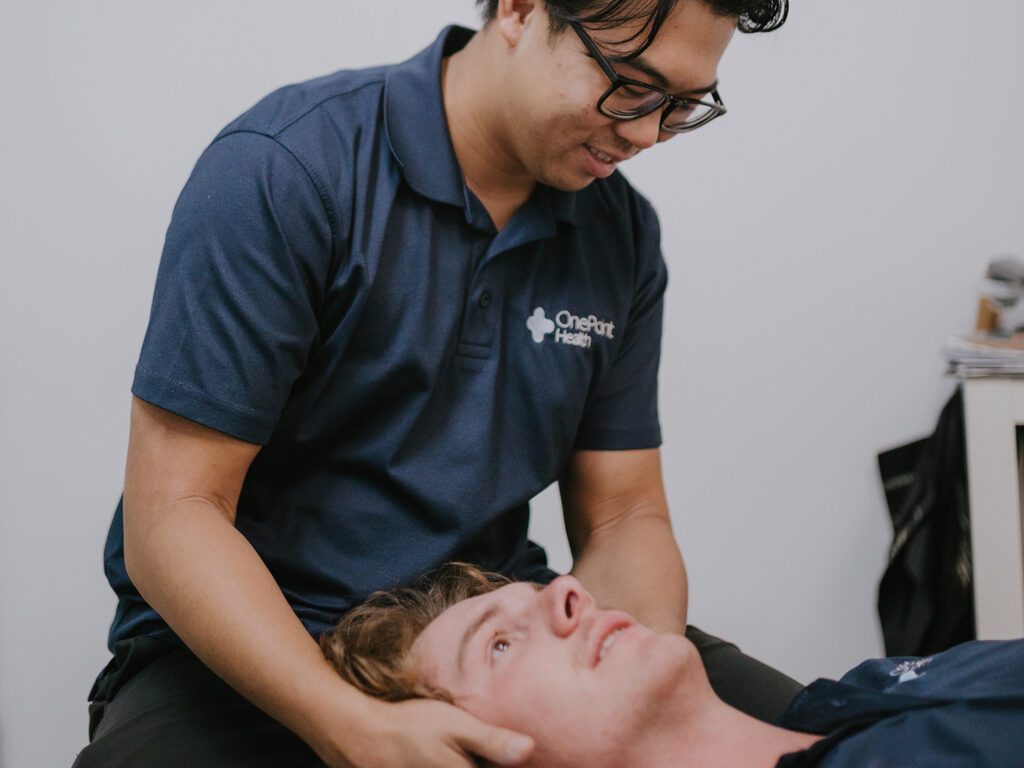
Understanding Neck pain
Neck pain is pain between the base of your skull and the tops of your shoulders. It can be a dull ache, a sharp catch when you turn, stiffness that is worst in the morning, or pain that spreads into your shoulder blade, arm or head.
Neck pain is a symptom, not a diagnosis. The job of your first appointment is to work out which structures are involved, whether nerves are affected, and what is keeping it going. That answer shapes the treatment.
Who does it affect?
desk workers, students, tradespeople, new parents and anyone who trains with overhead or heavy loads.
How common is it?
around two in three Australians experience neck pain at some point. [CONFIRM: source and figure]
What is the recovery like?
most mechanical neck pain improves with treatment and movement, though the timeframe varies from person to person.
Who should I see for treatment?
chiropractors and physiotherapists at OnePointHealth.
What funding options are available?
Medicare, NDIS, DVA and private health funds accepted.
What causes neck pain?
Your neck is seven small vertebrae, the discs and joints between them, and the muscles and nerves that control and supply the whole area. It holds up a head weighing roughly five kilograms while you turn, tilt and look down at a screen all day.
Most neck pain is mechanical. That means it comes from the joints, discs, muscles or nerves themselves rather than from disease. It often builds quietly over weeks, then flares after a long drive, a heavy session at the gym or an awkward night’s sleep. Sometimes it arrives overnight and you wake unable to turn your head.
Common contributors include:
Sustained positions: hours at a laptop, on a phone, or in a car, where the same tissues hold load without a break.
Muscle overload: the deep neck muscles fatigue, so the larger surface muscles take over and stay switched on.
Joint stiffness: the small facet joints between vertebrae lose their normal glide, which limits rotation and refers pain locally.
Disc changes: the disc bulges or dries out, which can irritate nearby nerves and send symptoms into the arm.
Injury: whiplash from a car accident, a fall, or a knock in contact sport.
Stress and poor sleep: both raise resting muscle tone and lower your tolerance to pain.
Symptoms of Neck pain
Neck pain presents in a few recognisable patterns:
Stiffness and reduced rotation, so reversing the car or checking a blind spot becomes difficult.
A sharp catch at a certain point in the range of movement, then relief once you move past it.
A deep ache across the top of the shoulders and between the shoulder blades.
Pain that is worst first thing in the morning, or worst by late afternoon after a day at a desk.
Headache that starts at the base of the skull and wraps forward.
Pins and needles, numbness or weakness travelling into the shoulder, arm or hand.
Your assessment decides the plan, not the label
What to expect at your first appointment
Tell us what is going on
You explain when the pain started, what makes it worse, where it travels, and what you have already tried.
A full assessment
Your practitioner tests your neck movement, checks the joints segment by segment, and screens your nerves, shoulders and upper back.
A clear plan
You get an explanation of what is driving the pain, the treatment options, and what you can do between visits.
Review and adjust
At follow-up, your practitioner retests the movements that hurt and changes the plan based on what has improved.
When to book an appointment
Your neck pain has lasted more than two weeks without clear improvement.
You cannot turn your head enough to drive, train or sleep comfortably.
Stretching, heat and over-the-counter pain relief have stopped helping.
You are not sure whether the pain is coming from your neck, your shoulder or a nerve.
Book an assessment if:
Looking after yourself at home
These steps support treatment; they are not a substitute for having the cause assessed.
Sustained positions: hours at a laptop, on a phone, or in a car, where the same tissues hold load without a break.
Muscle overload: the deep neck muscles fatigue, so the larger surface muscles take over and stay switched on.
Joint stiffness: the small facet joints between vertebrae lose their normal glide, which limits rotation and refers pain locally.
Disc changes: the disc bulges or dries out, which can irritate nearby nerves and send symptoms into the arm.
Injury: whiplash from a car accident, a fall, or a knock in contact sport.
Stress and poor sleep: both raise resting muscle tone and lower your tolerance to pain.

Meet the team who treat this
Behind every appointment is a team of practitioners who know each other, trust each other and work together for you. Across seven clinics and nine disciplines, our team shares expertise, coordinates treatment plans and celebrates your progress together.

Aimee Fuller
Healthcare Support Officer
Available at Blaxland

Alicia Whiticker
Healthcare Support Officer
Available at Blaxland

Amanda Banks
Healthcare Support Officer
Available at Blaxland

Amanda Duggan
Healthcare Support Officer
Available at Blaxland

Amy Meekings
Healthcare Support Officer
Available at Blaxland

Anita Beerapu
Healthcare Support Officer
Available at Blaxland

Benjamin Tucker
Healthcare Support Officer
Available at Blaxland

Blake Cossar
Healthcare Support Officer
Available at Blaxland

Bronte Tupper
Healthcare Support Officer
Available at Blaxland

Chris Farrugia
Healthcare Support Officer
Available at Blaxland

Corrina Aitken
Healthcare Support Officer
Available at Blaxland

David Logue
Healthcare Support Officer
Available at Blaxland

Dean Gresser
Healthcare Support Officer
Available at Blaxland

Emma Nassif
Healthcare Support Officer
Available at Blaxland

Esha Sharma
Healthcare Support Officer
Available at Blaxland

Fatima Hussaini
Healthcare Support Officer
Available at Blaxland

Felicity Spencer-Davey
Healthcare Support Officer
Available at Blaxland

Frankie Raikadroka
Healthcare Support Officer
Available at Blaxland

Hannah Norrie
Healthcare Support Officer
Available at Blaxland

Heather Edwards
Healthcare Support Officer
Available at Blaxland

Isaac Vella
Healthcare Support Officer
Available at Blaxland

Jarrah Nesbitt
Healthcare Support Officer
Available at Blaxland

Jonathan Lopez
Healthcare Support Officer
Available at Blaxland

Justin Hanna
Healthcare Support Officer
Available at Blaxland

Kasey Collins
Healthcare Support Officer
Available at Blaxland

Katrina Gauci
Healthcare Support Officer
Available at Blaxland

Kennedy Touet
Healthcare Support Officer
Available at Blaxland

Kristy Edwards
Healthcare Support Officer
Available at Blaxland

Kyle Perry
Healthcare Support Officer
Available at Blaxland

Lorna Nicastri
Healthcare Support Officer
Available at Blaxland

Maja Bosic
Healthcare Support Officer
Available at Blaxland

Marxy Koronel
Healthcare Support Officer
Available at Blaxland

Matt Barton
Healthcare Support Officer
Available at Blaxland

Michael Todd
Healthcare Support Officer
Available at Blaxland

Mr Jeffery Jenkins FACPS
Healthcare Support Officer
Available at Blaxland

Nathan Cavanagh
Healthcare Support Officer
Available at Blaxland

Patrick Celeban
Healthcare Support Officer
Available at Blaxland

Praise Khin
Healthcare Support Officer
Available at Blaxland

Sarah Bonnici
Healthcare Support Officer
Available at Blaxland

Shannon Smith
Healthcare Support Officer
Available at Blaxland

Siobhan Kelly
Healthcare Support Officer
Available at Blaxland

Taleisha Bozzi
Healthcare Support Officer
Available at Blaxland

Trystan Singh
Healthcare Support Officer
Available at Blaxland

Uty Kotwal
Healthcare Support Officer
Available at Blaxland

Yoni Hochberg
Healthcare Support Officer
Available at Blaxland

Zak Lloyd
Healthcare Support Officer
Available at Blaxland
EPC, DVA, NDIS and WorkCover welcome
Nearly half of our appointments are funded through Medicare, DVA, NDIS or WorkCover. We manage the paperwork so you can focus on your health.


NDIS
We support eligible NDIS participants across podiatry, physiotherapy, exercise physiology, dietetics and psychology, depending on your plan and goals. Eligibility and funding are set by your plan.

Medicare
Medicare may rebate podiatry, physiotherapy, exercise physiology and dietetics sessions when your GP refers you under an Enhanced Primary Care (EPC) or Chronic Disease Management (CDM) plan, and psychology sessions under a Mental Health Care Plan. The number of sessions is set by your plan.

DVA
Gold and White card holders can access DVA-funded care across our services with a valid referral.

WorkCover
If you have been injured at work, we accept WorkCover referrals for physiotherapy, exercise physiology and psychology, and manage the paperwork with your insurer, with a clear return-to-work plan.
Seven clinics across three regions
Find a clinic near you. Each location is staffed by local practitioners who know your community.
Penrith
Western SydneyOur largest centre, with our full range of services under one roof.
Ropes Crossing
Western SydneyPodiatry, at Ropes Crossing Village.
Blaxland
Blue MountainsPodiatry, physiotherapy, exercise physiology and group classes.
Springwood
Blue MountainsPodiatry, dietetics and a boutique footwear store.
Katoomba
Blue MountainsPodiatry, physiotherapy and dietetics, in a restored 1914 cottage.
Ryde
North ShorePodiatry, physiotherapy, dietetics and exercise physiology, with a footwear store and gait analysis.
Lindfield
North ShorePodiatry, with mobile podiatry across the North Shore and Northern Beaches.
Ready to turn your head without thinking about it?
Book an assessment with a chiropractor or physiotherapist and find out what is actually causing your neck pain.
















Frequently asked questions
Should I see a chiropractor or a physiotherapist for neck pain?
Either can assess and treat mechanical neck pain, and both use hands-on treatment plus exercise. Chiropractors lean more towards joint-focused techniques, physiotherapists more towards graded exercise and rehabilitation, but there is real overlap. Choose based on what has worked for you before, or book with whoever is available first. Our practitioners refer internally when a different approach suits you better.
Can neck pain cause pins and needles in my arm or hand?
Yes. When a nerve root in the neck is compressed or irritated, symptoms travel along the path that nerve supplies, which can reach the shoulder, forearm, hand or individual fingers. The pattern helps identify which level of the neck is involved. Weakness, worsening numbness or symptoms in both arms need prompt assessment rather than waiting to see whether they settle.
Should I use heat or ice on my neck?
Heat suits stiffness and long-standing muscular tension, because it increases blood flow and helps muscles relax before you move. Ice suits a sharp, recent flare or a knock, where you want to calm things down. Fifteen minutes at a time is enough for either, with a layer of fabric between the pack and your skin. If one feels better than the other, use that one.
Can stress cause neck pain?
Stress does not damage your neck, but it changes how your neck behaves. Under pressure you breathe higher into the chest, hold your shoulders up and clench your jaw, which keeps the upper neck muscles working all day. Poor sleep then lowers your pain threshold. This is why neck pain often flares during busy work periods and settles on holidays without anything structural having changed.
Do I need a referral to see a physiotherapist or chiropractor for neck pain?
No. You can book directly with either, and most people do. A GP referral is only needed for specific funding pathways, such as a Chronic Disease Management plan through Medicare or certain DVA arrangements. Private health extras cover applies without a referral, and you claim on the spot with your card.
Is it safe to keep exercising while my neck hurts?
Usually yes, with changes. Walking, cycling and lower body work rarely aggravate the neck and help keep you moving. What often needs adjusting is overhead pressing, heavy shrugs, front-loaded carries and long sets on a bench with your head unsupported. Your practitioner will tell you which movements to hold back and when to reintroduce them, rather than asking you to stop training altogether.