

Plantar warts
Get that painful wart off your foot for good
That gritty, stone-in-your-shoe feeling under your foot can be a plantar wart, and chemist treatments often barely touch it. Plantar warts are treatable, and your podiatrist can confirm what you are dealing with at your first visit.
Medicare, NDIS, DVA and private health funds accepted.
Understanding Plantar warts
Plantar warts are small skin growths on the sole of your foot, caused by a common virus. Because your body weight presses them inward, they can feel like standing on a pebble and they can be painful to squeeze from the sides.
Warts can clear on their own, but plantar warts are often the stubborn ones. Podiatry treatment works by breaking down the infected skin and prompting your immune system to recognise and clear the virus.
Who does it affect?
anyone, and most often children, teenagers and people who use shared showers, pools and gym floors.
How common is it?
warts are one of the more frequent skin problems treated in podiatry.
What is the recovery like?
varies. Some warts settle after one or two treatments, others need a course over several months.
Who should I see for treatment?
your podiatrist.
What funding options are available?
Medicare, NDIS, DVA and private health funds accepted.
What are plantar warts?
A plantar wart is an area of skin on the sole of your foot infected with human papillomavirus, or HPV. The virus enters through tiny breaks in the skin and makes the surface layer grow thicker and rougher in one spot.
On the sole, the wart cannot grow outward the way it would on a hand, so pressure pushes it flat and inward. Hard skin builds over the top, which is why warts are so often mistaken for a corn or callus.
Things that make a plantar wart more likely:
Walking barefoot in change rooms, pool surrounds, gyms and shared bathrooms
Sweaty feet, or skin that stays damp inside shoes and socks
Cracks, cuts or peeling skin that give the virus a way in
A developing or lowered immune response, which is part of why children get them so often
Symptoms of Plantar warts
A rough, grainy patch on the sole, sometimes with a raised rim of hard skin
Tiny black dots in the middle of the lesion
Pain when you squeeze the wart from the sides, rather than pressing straight down
The sensation of a small stone under your foot when you walk
Skin lines that stop at the edge of the lesion instead of running through it
Several small warts clustered together, or a spread of tiny ones nearby
Your treatment starts with an assessment, because the right approach changes with the size, number, location and age of the wart, and with your general health.
What to expect at your first appointment
Tell us what is going on
How long the wart has been there, what you have already tried, whether it is painful and whether anyone at home has one too.
A full assessment
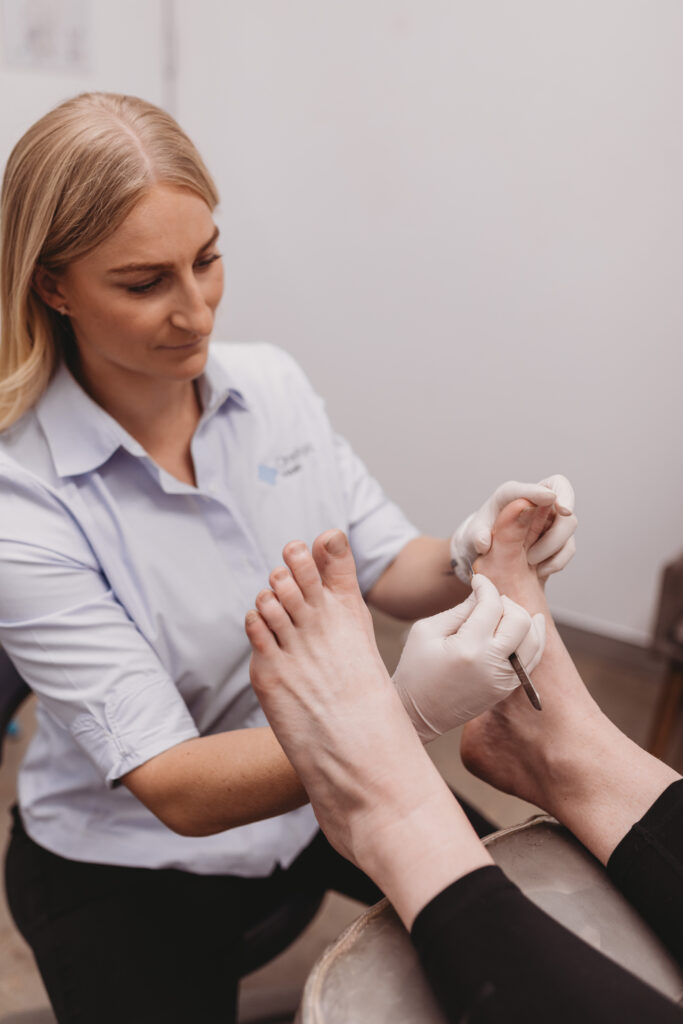
Your podiatrist examines the skin, pares back the surface to see the structure underneath, and confirms whether it is a wart, a corn or something else.
A clear plan
You will know which treatment is being recommended, roughly how many visits it may involve, and what happens between appointments.
Review and adjust
Warts respond at different rates, so your podiatrist checks progress and changes approach if the wart is not shifting.
When to book an appointment
The wart has been there longer than a few months and is not shrinking
It hurts to walk, run or stand for long periods
Chemist paints, patches or freeze kits have not worked
You are not sure whether it is a wart, a corn or something else
Book an assessment if:
Looking after yourself at home
These habits support treatment and reduce the chance of spreading the virus.
Walking barefoot in change rooms, pool surrounds, gyms and shared bathrooms
Sweaty feet, or skin that stays damp inside shoes and socks
Cracks, cuts or peeling skin that give the virus a way in
A developing or lowered immune response, which is part of why children get them so often

Meet the team who treat this
Behind every appointment is a team of practitioners who know each other, trust each other and work together for you. Across seven clinics and nine disciplines, our team shares expertise, coordinates treatment plans and celebrates your progress together.

Aimee Fuller
Healthcare Support Officer
Available at Blaxland

Alicia Whiticker
Healthcare Support Officer
Available at Blaxland

Amanda Banks
Healthcare Support Officer
Available at Blaxland

Amanda Duggan
Healthcare Support Officer
Available at Blaxland

Amy Meekings
Healthcare Support Officer
Available at Blaxland

Anita Beerapu
Healthcare Support Officer
Available at Blaxland

Benjamin Tucker
Healthcare Support Officer
Available at Blaxland

Blake Cossar
Healthcare Support Officer
Available at Blaxland

Bronte Tupper
Healthcare Support Officer
Available at Blaxland

Chris Farrugia
Healthcare Support Officer
Available at Blaxland

Corrina Aitken
Healthcare Support Officer
Available at Blaxland

David Logue
Healthcare Support Officer
Available at Blaxland

Dean Gresser
Healthcare Support Officer
Available at Blaxland

Emma Nassif
Healthcare Support Officer
Available at Blaxland

Esha Sharma
Healthcare Support Officer
Available at Blaxland

Fatima Hussaini
Healthcare Support Officer
Available at Blaxland

Felicity Spencer-Davey
Healthcare Support Officer
Available at Blaxland

Frankie Raikadroka
Healthcare Support Officer
Available at Blaxland

Hannah Norrie
Healthcare Support Officer
Available at Blaxland

Heather Edwards
Healthcare Support Officer
Available at Blaxland

Isaac Vella
Healthcare Support Officer
Available at Blaxland

Jarrah Nesbitt
Healthcare Support Officer
Available at Blaxland

Jonathan Lopez
Healthcare Support Officer
Available at Blaxland

Justin Hanna
Healthcare Support Officer
Available at Blaxland

Kasey Collins
Healthcare Support Officer
Available at Blaxland

Katrina Gauci
Healthcare Support Officer
Available at Blaxland

Kennedy Touet
Healthcare Support Officer
Available at Blaxland

Kristy Edwards
Healthcare Support Officer
Available at Blaxland

Kyle Perry
Healthcare Support Officer
Available at Blaxland

Lorna Nicastri
Healthcare Support Officer
Available at Blaxland

Maja Bosic
Healthcare Support Officer
Available at Blaxland

Marxy Koronel
Healthcare Support Officer
Available at Blaxland

Matt Barton
Healthcare Support Officer
Available at Blaxland

Michael Todd
Healthcare Support Officer
Available at Blaxland

Mr Jeffery Jenkins FACPS
Healthcare Support Officer
Available at Blaxland

Nathan Cavanagh
Healthcare Support Officer
Available at Blaxland

Patrick Celeban
Healthcare Support Officer
Available at Blaxland

Praise Khin
Healthcare Support Officer
Available at Blaxland

Sarah Bonnici
Healthcare Support Officer
Available at Blaxland

Shannon Smith
Healthcare Support Officer
Available at Blaxland

Siobhan Kelly
Healthcare Support Officer
Available at Blaxland

Taleisha Bozzi
Healthcare Support Officer
Available at Blaxland

Trystan Singh
Healthcare Support Officer
Available at Blaxland

Uty Kotwal
Healthcare Support Officer
Available at Blaxland

Yoni Hochberg
Healthcare Support Officer
Available at Blaxland

Zak Lloyd
Healthcare Support Officer
Available at Blaxland
EPC, DVA, NDIS and WorkCover welcome
Nearly half of our appointments are funded through Medicare, DVA, NDIS or WorkCover. We manage the paperwork so you can focus on your health.


NDIS
We support eligible NDIS participants across podiatry, physiotherapy, exercise physiology, dietetics and psychology, depending on your plan and goals. Eligibility and funding are set by your plan.

Medicare
Medicare may rebate podiatry, physiotherapy, exercise physiology and dietetics sessions when your GP refers you under an Enhanced Primary Care (EPC) or Chronic Disease Management (CDM) plan, and psychology sessions under a Mental Health Care Plan. The number of sessions is set by your plan.

DVA
Gold and White card holders can access DVA-funded care across our services with a valid referral.

WorkCover
If you have been injured at work, we accept WorkCover referrals for physiotherapy, exercise physiology and psychology, and manage the paperwork with your insurer, with a clear return-to-work plan.
Seven clinics across three regions
Find a clinic near you. Each location is staffed by local practitioners who know your community.
Penrith
Western SydneyOur largest centre, with our full range of services under one roof.
Ropes Crossing
Western SydneyPodiatry, at Ropes Crossing Village.
Blaxland
Blue MountainsPodiatry, physiotherapy, exercise physiology and group classes.
Springwood
Blue MountainsPodiatry, dietetics and a boutique footwear store.
Katoomba
Blue MountainsPodiatry, physiotherapy and dietetics, in a restored 1914 cottage.
Ryde
North ShorePodiatry, physiotherapy, dietetics and exercise physiology, with a footwear store and gait analysis.
Lindfield
North ShorePodiatry, with mobile podiatry across the North Shore and Northern Beaches.
Ready to sort out that plantar wart?
Book a podiatry assessment and find out exactly what it is and how to treat it.
















Frequently asked questions
Can plantar warts spread to other parts of my body?
Yes. The virus can spread from one part of your foot to another, and to your hands, if you pick at the wart or file it and then touch other skin. This is called autoinoculation. Keeping the wart covered, washing your hands after any dressing change, and using a separate file for that area all reduce the risk. Warts can also pass between family members through shared bathroom floors and towels.
Why does my plantar wart have tiny black dots in it?
Those dots are small blood vessels that have clotted inside the wart, not dirt or seeds. Warts recruit their own blood supply, which is part of why they persist. When your podiatrist pares the surface back, those vessels may bleed in pinpoints, which helps confirm the diagnosis. A corn pared back the same way shows a dense white or glassy core instead, with no bleeding points.
Do plantar warts have roots that grow into the foot?
No. Warts sit in the outer layer of skin and do not have roots that reach into muscle or bone. They look deep because body weight presses them flat and hard skin builds over the top, so what you see on the surface is only part of the lesion. Once the overlying callus is pared away, the true size and depth become clear.
Do chemist wart treatments work on plantar warts?
Sometimes, though they are weaker than clinic-strength options and often fail on the sole because thick skin blocks the product from reaching the wart. Over-the-counter acids and freeze kits can also burn healthy skin around the lesion if applied without paring first. If you have used one for six to eight weeks without change, a podiatry assessment is the next sensible step.
Why do children and teenagers get plantar warts more often?
Their immune systems have not yet met many HPV strains, so the virus establishes more easily. Bare feet at school pools, gymnastics, dance and sport also mean more exposure. The upside is that warts in children frequently clear on their own within a year or two, so gentler treatment or monitoring is often reasonable when the wart is small and painless.
Will treatment leave a scar on the sole of my foot?
Usually not. Warts sit in the outer skin layers, so treatment aimed at that level generally heals without permanent marking. More aggressive approaches, including some surgical removal done elsewhere, carry a higher risk of scar tissue, which can be uncomfortable on a weight-bearing surface. Your podiatrist will factor the wart’s location into which option is recommended, particularly for warts under the heel or ball of the foot.