

Shoulder impingement
Lift your arm overhead without that catching pain
Reaching for a seatbelt or the top shelf sends a sharp pinch through the front or side of your shoulder, and lying on that side at night has become a problem. Shoulder impingement responds well to treatment, and most people improve without surgery.
Medicare, NDIS, DVA and private health funds accepted.
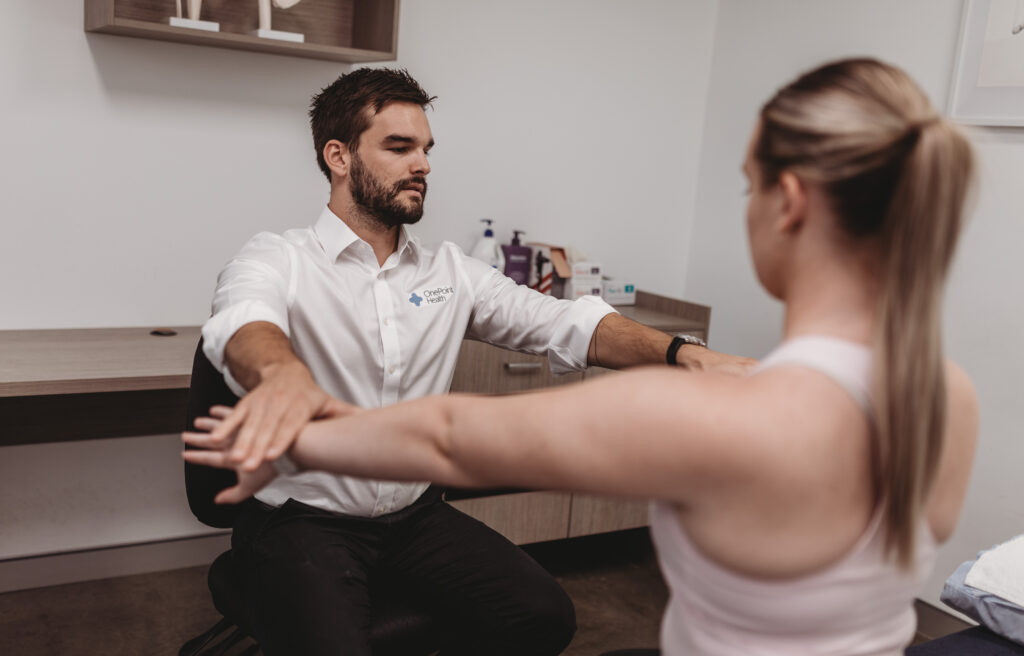
Understanding Shoulder impingement
Shoulder impingement is pain coming from the tendons and bursa in the narrow space under the bony point of your shoulder. Lifting your arm compresses those structures, which is why the pain appears through a band of movement rather than constantly.
Your physiotherapist checks how your shoulder and shoulder blade move, tests the rotator cuff muscles, then builds a plan around loading those tendons and restoring control. Surgery is rarely the first step.
Who does it affect?
people who work or train with their arms overhead, including swimmers, throwers, painters, trades and gym-goers, and it becomes more common with age.
How common is it?
shoulder pain is one of the most frequently reported musculoskeletal complaints in Australian adults, and impingement-type pain makes up a large share of it. [CONFIRM: prevalence source]
What is the recovery like?
varies from person to person, depending on how long the pain has been there, your general health and how much overhead load your work or sport demands.
Who should I see for treatment?
your physiotherapist, with referral to a GP or specialist if your assessment suggests it.
What funding options are available?
Medicare, NDIS, DVA and private health funds accepted.
What is shoulder impingement?
Shoulder impingement, also called subacromial pain, is pain from the rotator cuff tendons and the bursa that sit in the space between the top of your arm bone and the bony roof of your shoulder. When that space is loaded or compressed, those tissues become painful and sensitive.
It usually builds gradually rather than starting with one injury. A change in overhead activity, a heavier training block or a return to a sport after a break can load the tendons faster than they can adapt. The pain then makes you move differently, which loads the shoulder unevenly and keeps the cycle going.
Common contributing factors include:
A rapid increase in overhead lifting, throwing, swimming or pressing
Rotator cuff weakness, so the head of the arm bone sits and moves less efficiently
Poor control or stiffness through the shoulder blade and upper back
Age-related tendon changes, which make the tendon less tolerant of sudden load
Symptoms of Shoulder impingement
Sharp or pinching pain at the front or outside of the shoulder when you lift your arm
Pain reaching behind your back, into a jacket sleeve or up to a high shelf
Aching down the outside of the upper arm, usually stopping above the elbow
Difficulty sleeping on the affected side
Your plan comes out of the assessment, not a template
What to expect at your first appointment
Tell us what is going on
You explain which movements hurt, how long it has been there and what you need your shoulder to do at work and in sport.
A full assessment
Your physiotherapist tests your shoulder range, rotator cuff strength, shoulder blade control and your neck, because neck problems can refer pain to the same area.
A clear plan
You leave knowing what is causing your pain, what to change now and which exercises to start.
Review and adjust
At follow-up we retest your strength and painful movements, then progress the load.
When to book an appointment
Your shoulder pain isn’t improving, is getting worse, or is limiting your usual activities.
You cannot reach overhead, dress, or sleep on that side comfortably
Rest, ice or anti-inflammatory medication has not changed anything
You are unsure whether it is impingement, a tendon tear or your neck
Book an assessment if:
Looking after yourself at home
These general suggestions sit alongside your program, not instead of it.
A rapid increase in overhead lifting, throwing, swimming or pressing
Rotator cuff weakness, so the head of the arm bone sits and moves less efficiently
Poor control or stiffness through the shoulder blade and upper back
Age-related tendon changes, which make the tendon less tolerant of sudden load

Meet the team who treat this
Behind every appointment is a team of practitioners who know each other, trust each other and work together for you. Across seven clinics and nine disciplines, our team shares expertise, coordinates treatment plans and celebrates your progress together.

Aimee Fuller
Healthcare Support Officer
Available at Blaxland

Alicia Whiticker
Healthcare Support Officer
Available at Blaxland

Amanda Banks
Healthcare Support Officer
Available at Blaxland

Amanda Duggan
Healthcare Support Officer
Available at Blaxland

Amy Meekings
Healthcare Support Officer
Available at Blaxland

Anita Beerapu
Healthcare Support Officer
Available at Blaxland

Benjamin Tucker
Healthcare Support Officer
Available at Blaxland

Blake Cossar
Healthcare Support Officer
Available at Blaxland

Bronte Tupper
Healthcare Support Officer
Available at Blaxland

Chris Farrugia
Healthcare Support Officer
Available at Blaxland

Corrina Aitken
Healthcare Support Officer
Available at Blaxland

David Logue
Healthcare Support Officer
Available at Blaxland

Dean Gresser
Healthcare Support Officer
Available at Blaxland

Emma Nassif
Healthcare Support Officer
Available at Blaxland

Esha Sharma
Healthcare Support Officer
Available at Blaxland

Fatima Hussaini
Healthcare Support Officer
Available at Blaxland

Felicity Spencer-Davey
Healthcare Support Officer
Available at Blaxland

Frankie Raikadroka
Healthcare Support Officer
Available at Blaxland

Hannah Norrie
Healthcare Support Officer
Available at Blaxland

Heather Edwards
Healthcare Support Officer
Available at Blaxland

Isaac Vella
Healthcare Support Officer
Available at Blaxland

Jarrah Nesbitt
Healthcare Support Officer
Available at Blaxland

Jonathan Lopez
Healthcare Support Officer
Available at Blaxland

Justin Hanna
Healthcare Support Officer
Available at Blaxland

Kasey Collins
Healthcare Support Officer
Available at Blaxland

Katrina Gauci
Healthcare Support Officer
Available at Blaxland

Kennedy Touet
Healthcare Support Officer
Available at Blaxland

Kristy Edwards
Healthcare Support Officer
Available at Blaxland

Kyle Perry
Healthcare Support Officer
Available at Blaxland

Lorna Nicastri
Healthcare Support Officer
Available at Blaxland

Maja Bosic
Healthcare Support Officer
Available at Blaxland

Marxy Koronel
Healthcare Support Officer
Available at Blaxland

Matt Barton
Healthcare Support Officer
Available at Blaxland

Michael Todd
Healthcare Support Officer
Available at Blaxland

Mr Jeffery Jenkins FACPS
Healthcare Support Officer
Available at Blaxland

Nathan Cavanagh
Healthcare Support Officer
Available at Blaxland

Patrick Celeban
Healthcare Support Officer
Available at Blaxland

Praise Khin
Healthcare Support Officer
Available at Blaxland

Sarah Bonnici
Healthcare Support Officer
Available at Blaxland

Shannon Smith
Healthcare Support Officer
Available at Blaxland

Siobhan Kelly
Healthcare Support Officer
Available at Blaxland

Taleisha Bozzi
Healthcare Support Officer
Available at Blaxland

Trystan Singh
Healthcare Support Officer
Available at Blaxland

Uty Kotwal
Healthcare Support Officer
Available at Blaxland

Yoni Hochberg
Healthcare Support Officer
Available at Blaxland

Zak Lloyd
Healthcare Support Officer
Available at Blaxland
EPC, DVA, NDIS and WorkCover welcome
Nearly half of our appointments are funded through Medicare, DVA, NDIS or WorkCover. We manage the paperwork so you can focus on your health.


NDIS
We support eligible NDIS participants across podiatry, physiotherapy, exercise physiology, dietetics and psychology, depending on your plan and goals. Eligibility and funding are set by your plan.

Medicare
Medicare may rebate podiatry, physiotherapy, exercise physiology and dietetics sessions when your GP refers you under an Enhanced Primary Care (EPC) or Chronic Disease Management (CDM) plan, and psychology sessions under a Mental Health Care Plan. The number of sessions is set by your plan.

DVA
Gold and White card holders can access DVA-funded care across our services with a valid referral.

WorkCover
If you have been injured at work, we accept WorkCover referrals for physiotherapy, exercise physiology and psychology, and manage the paperwork with your insurer, with a clear return-to-work plan.
Seven clinics across three regions
Find a clinic near you. Each location is staffed by local practitioners who know your community.
Penrith
Western SydneyOur largest centre, with our full range of services under one roof.
Ropes Crossing
Western SydneyPodiatry, at Ropes Crossing Village.
Blaxland
Blue MountainsPodiatry, physiotherapy, exercise physiology and group classes.
Springwood
Blue MountainsPodiatry, dietetics and a boutique footwear store.
Katoomba
Blue MountainsPodiatry, physiotherapy and dietetics, in a restored 1914 cottage.
Ryde
North ShorePodiatry, physiotherapy, dietetics and exercise physiology, with a footwear store and gait analysis.
Lindfield
North ShorePodiatry, with mobile podiatry across the North Shore and Northern Beaches.
Ready to reach overhead without that pinch?
Book a shoulder assessment and start a plan built around your shoulder, your work and your sport.
















Frequently asked questions
Is shoulder impingement the same as a rotator cuff tear?
No. Impingement describes pain from compression and overload of the tendons and bursa under the bony roof of the shoulder, while a tear is structural damage to the tendon itself. The two can overlap, and long-standing impingement pain sometimes sits alongside tendon changes. Testing strength against resistance in specific positions helps separate them, and treatment differs in how quickly load is progressed.
How is shoulder impingement different from frozen shoulder?
Impingement limits movement because of pain; frozen shoulder limits it because the joint capsule tightens. With frozen shoulder, someone else moving your arm for you does not increase the range, particularly when rotating the arm outwards. With impingement, you often keep most of your passive range even when lifting the arm yourself is painful. That difference changes the treatment plan significantly.
Is impingement still the right term?
Many physiotherapists and researchers now use “subacromial pain syndrome” instead. The older term suggests the problem is purely mechanical pinching, when research shows tendon capacity, load history and pain sensitivity all play a part. The name matters clinically, because it shifts treatment away from simply avoiding movement and towards building tolerance in the tendons.
Does a bone spur cause shoulder impingement?
Not on its own. Bone spurs and variations in the shape of the acromion appear on scans of plenty of people with no shoulder pain at all, so they are a possible contributor rather than a verdict. Your response to graded loading and the way symptoms behave day to day tell your physiotherapist more than the shape of the bone does.
Can shoulder impingement cause weakness in my arm?
Yes, though it is usually pain limiting the muscle rather than true loss of power. When lifting hurts, the rotator cuff switches on less effectively, and strength drops over weeks of guarding the arm. Weakness that persists when the movement is not painful is treated differently, so your physiotherapist tests strength in positions that reduce compression.
Is my desk setup or posture causing my shoulder impingement?
Posture is one factor among several, not the cause on its own. Sustained positions matter more than shape: hours of typing with your arms unsupported or reaching forward for a mouse loads the shoulder without variation. Adjusting chair height, keyboard distance and armrests helps, but it works best combined with strengthening, because the tendon still needs capacity.