

Sports massage
Train hard, recover properly, get back out there
Your legs feel heavy, your shoulders are tight and the same spot keeps pulling every time you train. Sports massage helps you recover between sessions and keeps small problems from becoming injuries.
Medicare, NDIS, DVA and private health funds accepted.
Understanding Sports massage
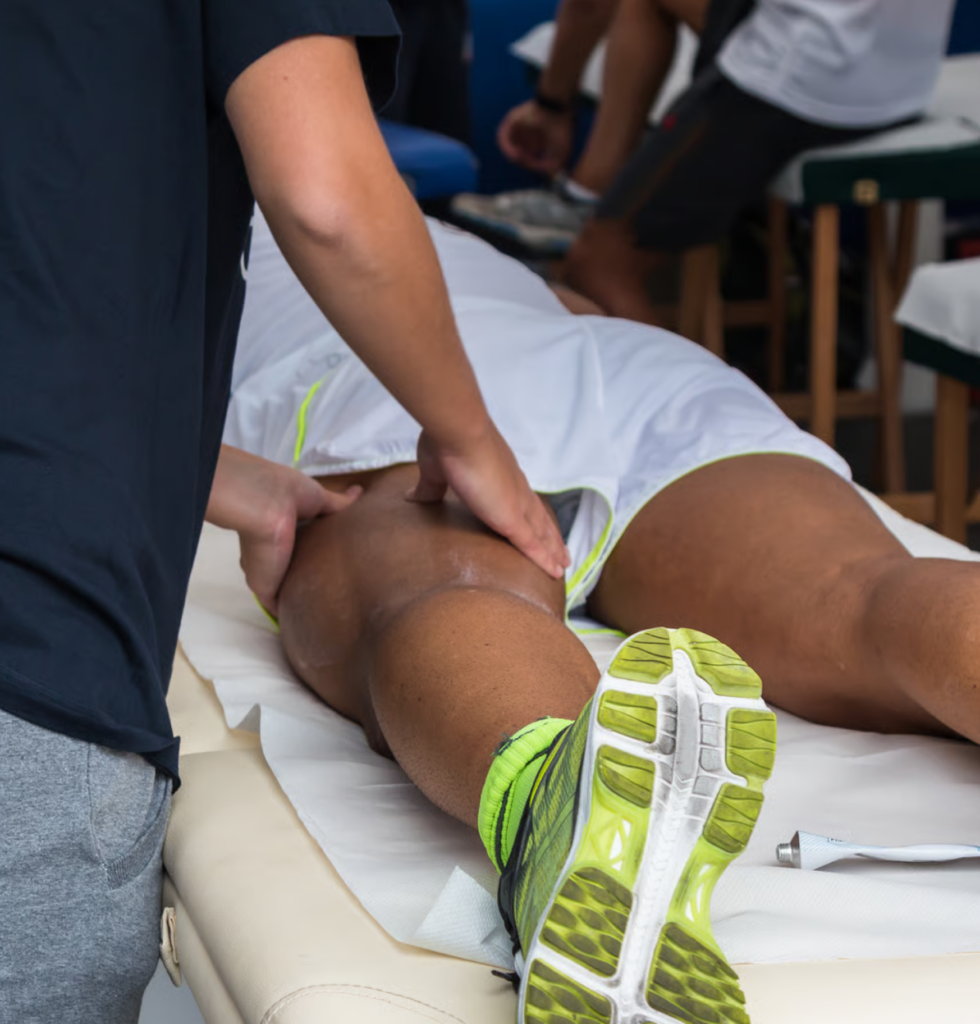
Sports massage is hands-on soft tissue treatment for people who train, compete or work physically. It targets the muscles you load most, using pressure, stretching and specific techniques to reduce tightness and help you move more freely.
You do not need to be an elite athlete. Runners, footballers, swimmers, gym-goers, weekend cyclists and tradies all use sports massage to manage training loads and stay consistent.
Who does it affect?
anyone with a regular training load or physically demanding work
How common is it?
soft tissue tightness is one of the most common reasons active people book massage
What is the recovery like?
many people feel looser the same day, though this varies
Who should I see for treatment?
your remedial massage therapist, with your physiotherapist involved when there is an injury
What funding options are available?
Medicare, NDIS, DVA and private health funds accepted
What is sports massage?
Sports massage is soft tissue treatment built around what your body is actually doing in training. Your therapist works on the muscles, tendons and fascia that carry your load, then adjusts pressure and technique to where you are in your week.
Tightness builds up when the work you ask of a muscle outpaces its capacity to recover. Sessions stack up, sleep drops off, a new program starts, and the same calf, hamstring or shoulder starts complaining. Left alone, that tightness changes how you move and shifts load somewhere else.
Common contributing factors include:
A sudden jump in training volume, intensity or hills
Returning to sport after a break or an injury
Repetitive movement patterns from one sport or one job
Limited range of motion through the hips, ankles or thoracic spine
Symptoms of Sports massage
Muscles that feel tight, heavy or restricted after training
A recurring pull or grabbing sensation in the same spot
Reduced range of motion through a hip, shoulder or ankle
Delayed onset muscle soreness that lingers between sessions
Feeling stiff at the start of every run, ride or session
Tension building through the neck and shoulders from training or work
Your session starts with a short assessment of your sport, your current training week and where the load is going.
What to expect at your first appointment
Tell us what is going on
Your sport, your training week, your event calendar and where it feels tight or painful.
A full assessment
Your therapist checks range of motion, tissue quality and how you move through the areas involved.
A clear plan
You get treatment on the day, plus a plan that fits around your training and any events coming up.
Review and adjust
At follow-up, your therapist checks what changed and adjusts pressure, technique and timing.
When to book an appointment
Tightness has lasted more than two weeks and is not settling with rest
You are dropping sessions, shortening runs or avoiding certain movements
Stretching, foam rolling and easy weeks have not made a difference
You are not sure whether it is tightness or an injury
Book an assessment if:
Looking after yourself at home
These steps support your treatment between appointments.
A sudden jump in training volume, intensity or hills
Returning to sport after a break or an injury
Repetitive movement patterns from one sport or one job
Limited range of motion through the hips, ankles or thoracic spine

Meet the team who treat this
Behind every appointment is a team of practitioners who know each other, trust each other and work together for you. Across seven clinics and nine disciplines, our team shares expertise, coordinates treatment plans and celebrates your progress together.

Aimee Fuller
Healthcare Support Officer
Available at Blaxland

Alicia Whiticker
Healthcare Support Officer
Available at Blaxland

Amanda Banks
Healthcare Support Officer
Available at Blaxland

Amanda Duggan
Healthcare Support Officer
Available at Blaxland

Amy Meekings
Healthcare Support Officer
Available at Blaxland

Anita Beerapu
Healthcare Support Officer
Available at Blaxland
Benjamin Tucker
Healthcare Support Officer
Available at Blaxland

Blake Cossar
Healthcare Support Officer
Available at Blaxland

Bronte Tupper
Healthcare Support Officer
Available at Blaxland

Chris Farrugia
Healthcare Support Officer
Available at Blaxland

Corrina Aitken
Healthcare Support Officer
Available at Blaxland

David Logue
Healthcare Support Officer
Available at Blaxland

Dean Gresser
Healthcare Support Officer
Available at Blaxland

Emma Nassif
Healthcare Support Officer
Available at Blaxland
Esha Sharma
Healthcare Support Officer
Available at Blaxland

Fatima Hussaini
Healthcare Support Officer
Available at Blaxland

Felicity Spencer-Davey
Healthcare Support Officer
Available at Blaxland

Frankie Raikadroka
Healthcare Support Officer
Available at Blaxland
Hannah Norrie
Healthcare Support Officer
Available at Blaxland

Heather Edwards
Healthcare Support Officer
Available at Blaxland

Isaac Vella
Healthcare Support Officer
Available at Blaxland
Jarrah Nesbitt
Healthcare Support Officer
Available at Blaxland

Jonathan Lopez
Healthcare Support Officer
Available at Blaxland

Justin Hanna
Healthcare Support Officer
Available at Blaxland

Kasey Collins
Healthcare Support Officer
Available at Blaxland

Katrina Gauci
Healthcare Support Officer
Available at Blaxland

Kennedy Touet
Healthcare Support Officer
Available at Blaxland

Kristy Edwards
Healthcare Support Officer
Available at Blaxland

Kyle Perry
Healthcare Support Officer
Available at Blaxland

Lorna Nicastri
Healthcare Support Officer
Available at Blaxland

Maja Bosic
Healthcare Support Officer
Available at Blaxland

Marxy Koronel
Healthcare Support Officer
Available at Blaxland

Matt Barton
Healthcare Support Officer
Available at Blaxland

Michael Todd
Healthcare Support Officer
Available at Blaxland

Mr Jeffery Jenkins FACPS
Healthcare Support Officer
Available at Blaxland

Nathan Cavanagh
Healthcare Support Officer
Available at Blaxland

Patrick Celeban
Healthcare Support Officer
Available at Blaxland

Praise Khin
Healthcare Support Officer
Available at Blaxland

Sarah Bonnici
Healthcare Support Officer
Available at Blaxland

Shannon Smith
Healthcare Support Officer
Available at Blaxland

Siobhan Kelly
Healthcare Support Officer
Available at Blaxland

Taleisha Bozzi
Healthcare Support Officer
Available at Blaxland

Trystan Singh
Healthcare Support Officer
Available at Blaxland

Uty Kotwal
Healthcare Support Officer
Available at Blaxland

Yoni Hochberg
Healthcare Support Officer
Available at Blaxland

Zak Lloyd
Healthcare Support Officer
Available at Blaxland
EPC, DVA, NDIS and WorkCover welcome
Nearly half of our appointments are funded through Medicare, DVA, NDIS or WorkCover. We manage the paperwork so you can focus on your health.

NDIS
We support eligible NDIS participants across podiatry, physiotherapy, exercise physiology, dietetics and psychology, depending on your plan and goals. Eligibility and funding are set by your plan.

Medicare
Medicare may rebate podiatry, physiotherapy, exercise physiology and dietetics sessions when your GP refers you under an Enhanced Primary Care (EPC) or Chronic Disease Management (CDM) plan, and psychology sessions under a Mental Health Care Plan. The number of sessions is set by your plan.

DVA
Gold and White card holders can access DVA-funded care across our services with a valid referral.

WorkCover
If you have been injured at work, we accept WorkCover referrals for physiotherapy, exercise physiology and psychology, and manage the paperwork with your insurer, with a clear return-to-work plan.
Seven clinics across three regions
Find a clinic near you. Each location is staffed by local practitioners who know your community.
Penrith
Western SydneyOur largest centre, with our full range of services under one roof.
Ropes Crossing
Western SydneyPodiatry, at Ropes Crossing Village.
Blaxland
Blue MountainsPodiatry, physiotherapy, exercise physiology and group classes.
Springwood
Blue MountainsPodiatry, dietetics and a boutique footwear store.
Katoomba
Blue MountainsPodiatry, physiotherapy and dietetics, in a restored 1914 cottage.
Ryde
North ShorePodiatry, physiotherapy, dietetics and exercise physiology, with a footwear store and gait analysis.
Lindfield
North ShorePodiatry, with mobile podiatry across the North Shore and Northern Beaches.
Ready to get your training back on track?
Book a sports massage that fits your training week and your next event.















Frequently asked questions
Do I need to be an athlete to have a sports massage?
No. Sports massage suits anyone with a repetitive physical load, including tradies, nurses, gardeners and people who lift at the gym twice a week. The techniques are chosen for how your body is being used, not for your competition level. If your work or training loads the same muscles over and over, the treatment applies to you in the same way.
How long before an event should I book a sports massage?
For firmer, deeper work, book at least three to five days before your event so any post-treatment heaviness has cleared. Lighter pre-event work can be done in the two days beforehand. Avoid a first-time deep session in race week. If you have an event coming up, tell your therapist the date at the start of the appointment.
Can I train straight after a sports massage?
Light movement is usually fine and often feels good. Heavy sessions, maximum efforts and long runs are better left until the next day, because your muscles may feel temporarily less responsive after firm work. Your therapist will tell you what to expect from the specific techniques used and how to time your next session around them.
What should I wear to a sports massage?
Wear or bring loose shorts and a singlet or sports top. Sports massage often involves active movement, stretching and joint range work, so being able to move helps. Towels are used for draping throughout, and you only undress to the level you are comfortable with. Let your therapist know if you would prefer to stay fully clothed.
Do I need a referral for a sports massage?
No referral is needed to book a sports massage. You can book directly online or by phone. A referral or care plan is only relevant if you are accessing funded care through Medicare, NDIS or DVA, and those pathways generally involve physiotherapy rather than massage alone. Our reception team can explain what applies to your situation.
Is sports massage worth it in the off-season?
Yes. The off-season is often the best time for deeper, more thorough work, because there is no event to protect and your body has time to adapt. Many people use this period to address long-standing restrictions, rebuild range of motion and start strength work before pre-season volume climbs again.