

Tennis elbow
Get your grip back without that pain on the outside of your elbow
Every kettle, coffee cup and door handle sends a sharp pain through the outside of your elbow, and your grip feels weaker than it should. Tennis elbow responds well to the right loading program, and your physiotherapist can build this for you.
Medicare, NDIS, DVA and private health funds accepted.
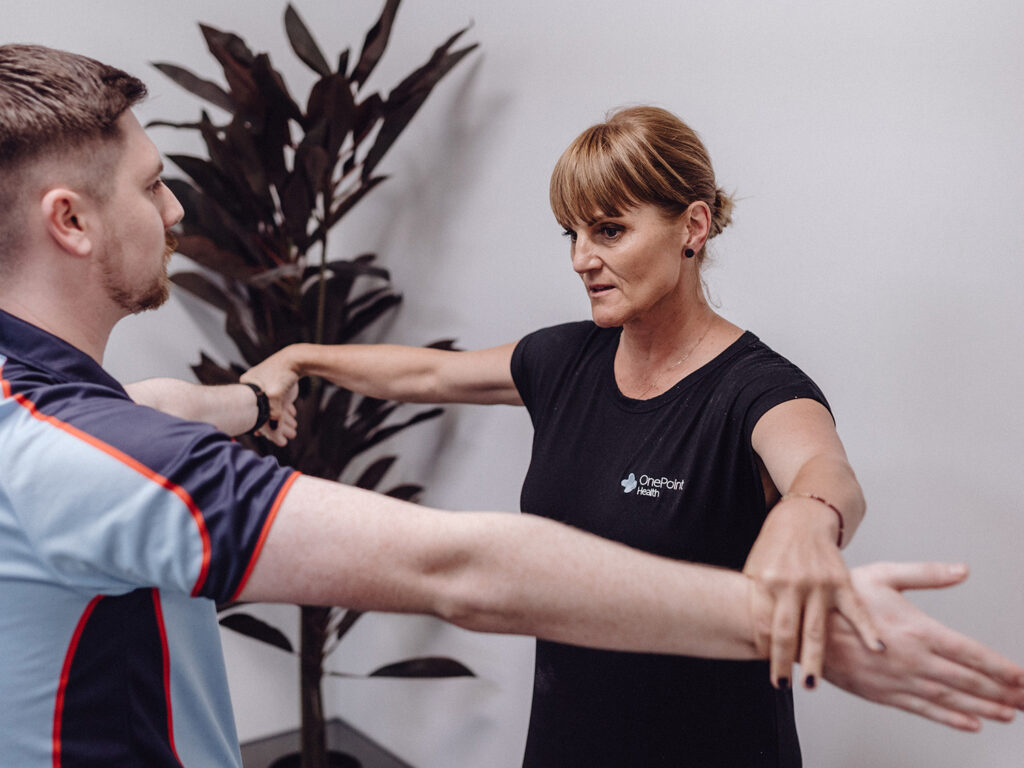
Understanding Tennis elbow
Tennis elbow is pain on the outside of the elbow. It comes from overload of the tendon that joins your wrist and finger extensor muscles to the bony bump on the outside of the elbow. Gripping, lifting and twisting are the movements that usually hurt.
Most people improve with a graded strength program that rebuilds the tendon’s tolerance to load, alongside changes to the tasks that keep flaring it up. Your physiotherapist gives you both, and adjusts the plan as your elbow responds.
Who does it affect?
adults aged roughly 35 to 55, most often in the dominant arm.
How common is it?
one of the most frequent causes of elbow pain in working-age adults.
What is the recovery like?
varies. Many people notice change within a few weeks, while a tendon can take several months to rebuild.
Who should I see for treatment?
your physiotherapist.
What funding options are available?
Medicare, NDIS, DVA and private health funds accepted.
What is tennis elbow?
Tennis elbow, or lateral epicondylalgia, is a tendinopathy: a change in the structure and pain sensitivity of a tendon that has been asked to do more than it can currently handle. The tendon involved sits on the outside of your elbow and controls the muscles that lift your wrist and straighten your fingers.
It usually builds up over weeks rather than starting with one clear injury. A new task, a busier stretch at work or a jump in training volume loads the tendon faster than it can adapt. The tendon becomes painful, your grip weakens, and you start avoiding the movements that hurt, which lowers your tolerance further.
Contributing factors include:
Repetitive gripping, twisting or lifting at work, such as trade work, hairdressing or hospitality
A sudden increase in racquet sport, gym or garden work volume
Weakness through your wrist, forearm, shoulder blade or shoulder
Equipment that does not suit you, including grip size, racquet string tension or tool weight
Age-related change in tendon quality
A previous episode of elbow pain that never fully settled
Symptoms of Tennis elbow
Tennis elbow usually presents as:
Pain on the outside of the elbow, sometimes spreading down into your forearm
Pain when you grip, shake hands, pour a kettle or turn a key
A tender spot you can press on over the bony bump on the outside of the elbow
Weakness when you carry a bag or hold something at arm's length
Stiffness and soreness in the elbow first thing in the morning
Pain that eases with rest and returns as soon as you go back to the task
Your plan comes out of the assessment, because the tendon load driving your pain is rarely the same as the next person's.
What to expect at your first appointment
Tell us what is going on
You describe when the pain started, what makes it worse, and what your work, sport and daily load look like.
A full assessment
Your physiotherapist tests your grip strength, elbow, wrist and shoulder, and rules out nerve and joint causes.
A clear plan
You leave knowing what is driving your pain, which exercises to start, and what to change in the meantime.
Review and adjust
At follow-up we recheck your grip and pain response, then progress your loading as your tendon tolerates more.
When to book an appointment
Your elbow pain has lasted more than two to three weeks
You are struggling to grip, lift or work because of the pain
Rest, ice and over-the-counter medication have not changed anything
You are not sure whether it is a tendon, a joint or a nerve problem
Book an assessment if:
Looking after yourself at home
These steps help alongside treatment, and work best once you know what is driving your pain.
Repetitive gripping, twisting or lifting at work, such as trade work, hairdressing or hospitality
A sudden increase in racquet sport, gym or garden work volume
Weakness through your wrist, forearm, shoulder blade or shoulder
Equipment that does not suit you, including grip size, racquet string tension or tool weight
Age-related change in tendon quality
A previous episode of elbow pain that never fully settled

Meet the team who treat this
Behind every appointment is a team of practitioners who know each other, trust each other and work together for you. Across seven clinics and nine disciplines, our team shares expertise, coordinates treatment plans and celebrates your progress together.

Aimee Fuller
Healthcare Support Officer
Available at Blaxland

Alicia Whiticker
Healthcare Support Officer
Available at Blaxland

Amanda Banks
Healthcare Support Officer
Available at Blaxland

Amanda Duggan
Healthcare Support Officer
Available at Blaxland

Amy Meekings
Healthcare Support Officer
Available at Blaxland

Anita Beerapu
Healthcare Support Officer
Available at Blaxland

Benjamin Tucker
Healthcare Support Officer
Available at Blaxland

Blake Cossar
Healthcare Support Officer
Available at Blaxland

Bronte Tupper
Healthcare Support Officer
Available at Blaxland

Chris Farrugia
Healthcare Support Officer
Available at Blaxland

Corrina Aitken
Healthcare Support Officer
Available at Blaxland

David Logue
Healthcare Support Officer
Available at Blaxland

Dean Gresser
Healthcare Support Officer
Available at Blaxland

Emma Nassif
Healthcare Support Officer
Available at Blaxland

Esha Sharma
Healthcare Support Officer
Available at Blaxland

Fatima Hussaini
Healthcare Support Officer
Available at Blaxland

Felicity Spencer-Davey
Healthcare Support Officer
Available at Blaxland

Frankie Raikadroka
Healthcare Support Officer
Available at Blaxland

Hannah Norrie
Healthcare Support Officer
Available at Blaxland

Heather Edwards
Healthcare Support Officer
Available at Blaxland

Isaac Vella
Healthcare Support Officer
Available at Blaxland

Jarrah Nesbitt
Healthcare Support Officer
Available at Blaxland

Jonathan Lopez
Healthcare Support Officer
Available at Blaxland

Justin Hanna
Healthcare Support Officer
Available at Blaxland

Kasey Collins
Healthcare Support Officer
Available at Blaxland

Katrina Gauci
Healthcare Support Officer
Available at Blaxland

Kennedy Touet
Healthcare Support Officer
Available at Blaxland

Kristy Edwards
Healthcare Support Officer
Available at Blaxland

Kyle Perry
Healthcare Support Officer
Available at Blaxland

Lorna Nicastri
Healthcare Support Officer
Available at Blaxland

Maja Bosic
Healthcare Support Officer
Available at Blaxland

Marxy Koronel
Healthcare Support Officer
Available at Blaxland

Matt Barton
Healthcare Support Officer
Available at Blaxland

Michael Todd
Healthcare Support Officer
Available at Blaxland

Mr Jeffery Jenkins FACPS
Healthcare Support Officer
Available at Blaxland

Nathan Cavanagh
Healthcare Support Officer
Available at Blaxland

Patrick Celeban
Healthcare Support Officer
Available at Blaxland

Praise Khin
Healthcare Support Officer
Available at Blaxland

Sarah Bonnici
Healthcare Support Officer
Available at Blaxland

Shannon Smith
Healthcare Support Officer
Available at Blaxland

Siobhan Kelly
Healthcare Support Officer
Available at Blaxland

Taleisha Bozzi
Healthcare Support Officer
Available at Blaxland

Trystan Singh
Healthcare Support Officer
Available at Blaxland

Uty Kotwal
Healthcare Support Officer
Available at Blaxland

Yoni Hochberg
Healthcare Support Officer
Available at Blaxland

Zak Lloyd
Healthcare Support Officer
Available at Blaxland
EPC, DVA, NDIS and WorkCover welcome
Nearly half of our appointments are funded through Medicare, DVA, NDIS or WorkCover. We manage the paperwork so you can focus on your health.

NDIS
We support eligible NDIS participants across podiatry, physiotherapy, exercise physiology, dietetics and psychology, depending on your plan and goals. Eligibility and funding are set by your plan.

Medicare
Medicare may rebate podiatry, physiotherapy, exercise physiology and dietetics sessions when your GP refers you under an Enhanced Primary Care (EPC) or Chronic Disease Management (CDM) plan, and psychology sessions under a Mental Health Care Plan. The number of sessions is set by your plan.

DVA
Gold and White card holders can access DVA-funded care across our services with a valid referral.

WorkCover
If you have been injured at work, we accept WorkCover referrals for physiotherapy, exercise physiology and psychology, and manage the paperwork with your insurer, with a clear return-to-work plan.
Seven clinics across three regions
Find a clinic near you. Each location is staffed by local practitioners who know your community.
Penrith
Western SydneyOur largest centre, with our full range of services under one roof.
Ropes Crossing
Western SydneyPodiatry, at Ropes Crossing Village.
Blaxland
Blue MountainsPodiatry, physiotherapy, exercise physiology and group classes.
Springwood
Blue MountainsPodiatry, dietetics and a boutique footwear store.
Katoomba
Blue MountainsPodiatry, physiotherapy and dietetics, in a restored 1914 cottage.
Ryde
North ShorePodiatry, physiotherapy, dietetics and exercise physiology, with a footwear store and gait analysis.
Lindfield
North ShorePodiatry, with mobile podiatry across the North Shore and Northern Beaches.
Ready to sort out that elbow pain?
Book a physiotherapy assessment and get a loading plan built around your arm and your workload.
















Frequently asked questions
Can you get tennis elbow without playing tennis?
Yes, and most people with tennis elbow have never picked up a racquet. The condition is named after the sport, but it is far more common in tradespeople, hairdressers, chefs, cleaners, new parents and office workers. Anything that involves repeated gripping, twisting or holding a weight at arm’s length can load the tendon past its current capacity. The task matters more than the sport.
What is the difference between tennis elbow and golfer's elbow?
Tennis elbow affects the tendon on the outside of the elbow, and golfer’s elbow affects the tendon on the inside. Tennis elbow hurts most when you lift your wrist or grip with the palm down. Golfer’s elbow hurts when you bend your wrist or squeeze with the palm up. Both are tendinopathies, both respond to graded loading, but the exercises target different muscle groups.
Is tennis elbow caused by inflammation?
Mostly, no. Older names like tennis elbow tendonitis suggested inflammation, but tissue studies show the tendon has usually undergone structural change and disorganised repair rather than active inflammation. This matters for treatment: anti-inflammatory measures alone rarely fix it, because the tendon needs progressive load to remodel. In the first days of a sudden flare there can be an inflammatory component, which is why very early management sometimes differs.
Does a tennis elbow brace actually work?
A counterforce brace can reduce pain during gripping tasks for some people, which makes it a useful short-term tool. It sits on the forearm below the elbow and changes how force transfers through the tendon. It does not strengthen anything, so it works best worn for specific aggravating activities rather than all day. Your physiotherapist will check placement and tension, because a brace worn too tight can irritate the forearm.
Will tennis elbow go away on its own?
Some cases settle without treatment, but a significant number of people still have symptoms a year later, and recurrence is common when grip strength has not been rebuilt. Waiting also tends to mean months of modified work and avoided activity. Starting a structured loading program earlier gives the tendon a reason to adapt rather than simply waiting for the flare to pass.
Can I keep working at a computer with tennis elbow?
Usually yes, with adjustments. Long periods of mouse use with the wrist extended keep the tendon under low-level load all day, which is often enough to stop it settling. Bring your mouse closer to your body, support your forearm on the desk, drop your keyboard so your wrists sit flat, and break up long stretches of typing. A vertical mouse suits some people. Your physiotherapist can review your set-up.